Taxes rarely top the list of reasons someone dreams of moving to Spain, but they quietly shape nearly every decision that follows: which visa route makes sense, whether to register as autónomo or form a company, even which region to settle in. Understanding the system early, rather than reacting to it later, is what separates a smooth transition from a costly surprise.
Spain’s tax rules genuinely differ depending on who you are and how long you plan to stay. A few questions worth keeping in mind as you read:
- Are you a tax resident, or not, and does that change more than you’d expect?
- Does your income come from employment, freelance work, investments, or property, and does that change your rate?
- Could a special regime like the Beckham Law meaningfully lower what you owe?
This guide walks through Spain’s tax system as it applies specifically to foreigners: residency rules, income tax, VAT, property and investment taxes, wealth tax, inheritance rules, and the special regimes worth knowing about. We’ll also flag exactly where this connects to the business, visa, and investment topics covered elsewhere in this series.
Who Has to Pay Tax in Spain?
Every tax question in this guide ultimately traces back to a single classification: are you a Spanish tax resident, or not? Get this wrong, and everything downstream, from which forms you file to how much you actually owe, follows from a flawed foundation.
Tax Resident vs Non-Resident
Spain taxes residents and non-residents under two entirely separate systems:
| Tax Resident | Non-Resident | |
|---|---|---|
| Scope of taxation | Worldwide income and assets | Spanish-source income only |
| Governing tax | IRPF (progressive) | IRNR (generally flat rates) |
| Filing | Annual income tax return | Per-income-type declarations (Modelo 210) |
| Wealth tax exposure | Worldwide assets | Spanish-situated assets only |
This distinction shapes everything else in this guide, so it’s worth reading the criteria below carefully rather than assuming your visa type or how long you’ve lived somewhere else automatically determines your Spanish tax status.
The 183-Day Rule and Other Residency Criteria
Spain determines tax residency using three separate tests, and meeting any one of them is enough to make you a tax resident:
- Physical presence: spending more than 183 days in Spain during a calendar year, counting sporadic absences unless you can prove tax residency elsewhere
- Economic center of interest: having the main base of your economic or professional activities located in Spain, even if you spend fewer than 183 days physically present
- Family presumption: if your spouse and dependent minor children live in Spain, you’re presumed to be a tax resident too, unless proven otherwise
The family presumption catches people off guard more than any other rule here. Someone genuinely splitting time between countries, with a spouse and kids settled in Spain, can be classified as a tax resident even while personally spending fewer than 183 days there.
How to Determine Your Tax Residency
Given how consequential this classification is, and how easily the three tests above can overlap or conflict with another country’s own residency rules, this is genuinely one of the areas of Spanish tax law where a professional assessment early is worth far more than guessing. Double taxation treaties, covered later in this guide, often include tie-breaker rules for exactly this kind of cross-border ambiguity.
Getting Your Tax ID (NIE/NIF)
As covered throughout this series, the NIE functions as your tax ID once activated with Hacienda, while companies receive a separate NIF. Without one of these, you can’t file a Spanish tax return, open certain accounts, or complete most formal transactions, making it the practical first step before any tax question in this guide becomes actionable.
Personal Income Tax (IRPF)
Once your residency status is settled, IRPF becomes the tax that touches nearly everyone living and working in Spain long-term. It’s progressive, it’s genuinely regional, and it’s worth understanding in detail before your first Spanish payslip arrives.
Who Pays It
Any Spanish tax resident owes IRPF on their worldwide income, covering salaries, self-employment profit, pensions, and rental income. Non-residents fall outside IRPF entirely, taxed instead under the separate IRNR system covered elsewhere in this guide.
National and Regional Income Tax Rates
IRPF combines a fixed national scale with a regional scale set independently by each autonomous community, meaning the same salary can produce genuinely different tax bills depending on where you live.
The national brackets for 2026:
| Taxable Income | State Rate |
|---|---|
| Up to €12,450 | 19% |
| €12,450 to €20,200 | 24% |
| €20,200 to €35,200 | 30% |
| €35,200 to €60,000 | 37% |
| €60,000 to €300,000 | 45% |
| Above €300,000 | 47% |
Regional rates layer on top, and the gap between regions is significant:
- Madrid: lowest combined rates in Spain, topping out around 45%
- Catalonia: combined top rate exceeding 50% above roughly €175,000
- Valencia: Spain’s highest combined top rate, approaching 54%
- Basque Country and Navarra: operate under entirely separate foral tax regimes with their own distinct rules
On a €200,000 salary, the gap between registering as a resident in Madrid versus Valencia can exceed €9,000 a year. For anyone with flexibility over where in Spain they establish residency, this is genuinely worth factoring into the decision, not just an afterthought.
How Income Tax Is Calculated
IRPF splits income into two separate categories, each taxed differently:
- General income: employment, self-employment profit, and rental income, taxed under the progressive brackets above
- Savings income: dividends, interest, and capital gains, taxed under the separate savings scale covered in Investing in Spain article (19% to 30%)
Your final liability applies the relevant scale to each income type, then subtracts your applicable allowances before arriving at what’s actually owed.
Deductions, Allowances and Tax Credits
Every taxpayer benefits from a personal allowance (mínimo personal) of €5,550, rising to €6,700 for those over 65 and €8,100 for those over 75. This isn’t subtracted from income directly; rather, it reduces the tax calculated by effectively taxing that portion at the lowest bracket rate.
Additional allowances include:
- Family allowances for dependent children under 25: €2,400 for the first, €2,700 for the second, €4,000 for the third, and €4,500 for each additional child
- Employment income reduction, up to €2,000 for salaried workers
- Pension plan contributions, deductible up to €1,500 annually
Filing Your Tax Return
Deadlines
Spain’s annual income tax filing period (Declaración de la Renta) typically runs from early April to the end of June, covering the previous calendar year’s income. Missing this window can trigger surcharges even where no tax is ultimately owed.
How to File as a Foreigner
Foreign residents file the same Modelo 100 return as Spanish nationals, generally through the Agencia Tributaria’s online portal using a digital certificate or Cl@ve PIN, as covered in Starting a Business in Spain article. Given the regional complexity and the potential value of the Beckham Law regime covered later in this guide, most foreigners filing for the first time in Spain work with a gestor or tax advisor, at least for that initial return.
Taxes on Employment and Self-Employment Income
How your income is structured, salaried, remote, or self-employed, shapes far more than just your tax rate. It determines which forms you file, how often you file them, and which Social Security regime you fall under.

Salaried Employees (Spanish and Foreign Employers)
Employees working for a Spanish company have IRPF withheld directly from each paycheck (retenciones), based on estimated annual income, family situation, and applicable allowances. The employer handles this automatically, and any difference between what’s withheld and the actual final liability gets reconciled at annual filing.
Employees working remotely for a foreign employer while Spanish tax resident face a different situation: their employer typically isn’t set up to withhold Spanish tax, so the employee generally needs to make quarterly advance payments themselves, similar to the freelancer process covered below, to avoid a large lump sum owed at filing time.
Remote Workers
Remote workers occupy a genuinely distinct tax position, and one that connects directly to Spain Digital Nomad Visa article’s Digital Nomad Visa coverage. A few points worth reiterating here specifically from a tax angle:
- Becoming a Spanish tax resident (crossing 183 days, as covered earlier) generally triggers worldwide income taxation regardless of where the paying company is based
- Many remote workers qualify for the Beckham Law, covered in full later in this guide, which can meaningfully reduce their effective rate
- Without Beckham Law eligibility, remote employees of foreign companies typically need to self-manage quarterly tax payments, since there’s no Spanish payroll system automatically withholding on their behalf
Freelancers and Autónomos
Freelancers and self-employed individuals registered as autónomos face the most hands-on tax obligations of any income type covered here, but also the most direct control over their own deductions and timing.
Social Security Contributions
Autónomos register under RETA, Spain’s special Social Security regime for the self-employed, contributing monthly based on a progressive bracket system tied to estimated net income:
- Select an income bracket at registration, based on projected annual profit
- Adjust the bracket up to six times a year as actual income becomes clearer
- Face a year-end reconciliation, where Social Security compares contributions paid against actual declared income
Monthly contributions generally start around €200 to €230 at the lowest bracket, rising considerably for higher income levels.
Quarterly Tax Obligations
Unlike salaried employees, autónomos don’t have tax withheld automatically, so Spain requires quarterly advance payments throughout the year:
| Form | Purpose | Frequency |
|---|---|---|
| Modelo 130 | IRPF advance payment (roughly 20% of net profit) | Quarterly |
| Modelo 303 | VAT (IVA) declaration | Quarterly |
| Modelo 100 | Annual income tax reconciliation | Annually |
Missing a quarterly filing deadline isn’t just an administrative slip. Spain applies surcharges and interest on late payments, and repeated missed filings can trigger closer scrutiny from the tax agency. Setting calendar reminders, or working with a gestor who manages this on your behalf, tends to be one of the highest-value low-cost decisions a new autónomo can make.
Taken together, these three income types (salaried, remote, and self-employed) illustrate a consistent theme running through Spanish tax law: the more control you have over how and when you’re paid, the more responsibility falls on you to manage your own tax compliance proactively, rather than relying on automatic withholding to handle it for you.
VAT (IVA) in Spain
VAT touches nearly every transaction in Spain, and while the core mechanics are similar to VAT systems elsewhere in the EU, the specific rates, registration rules, and cross-border treatment are worth understanding clearly, especially for freelancers and business owners covered throughout this series.
VAT Rates
Spain applies three VAT rates depending on the type of goods or services involved:
| Rate | Applies To |
|---|---|
| 21% (standard) | Most goods and services |
| 10% (reduced) | Hospitality, certain food categories, passenger transport |
| 4% (super-reduced) | Basic staples, books, newspapers, certain medicines |
Some professional activities, notably healthcare, education, and certain financial and insurance services, are VAT-exempt entirely, which affects how those businesses handle invoicing and whether they can reclaim VAT on their own purchases.
Who Must Register
Any individual or business carrying out an economic activity in Spain generally needs to register for VAT purposes as part of the census declaration (Modelo 036/037), regardless of expected turnover. Unlike some countries, Spain doesn’t apply a minimum revenue threshold before VAT registration becomes mandatory for most standard business activities.
VAT for Freelancers and Businesses
Both autónomos and companies generally:
- Charge VAT on their invoices at the applicable rate
- Pay VAT on eligible business purchases and expenses
- Reclaim that input VAT against the VAT collected from clients
- Remit the net difference to the tax authorities each quarter
For freelancers specifically, this means every invoice issued needs to clearly show the VAT rate applied, alongside a separate line for any IRPF withholding, since many freelance invoices to Spanish businesses also carry an income tax retention on top of VAT.
VAT on Services to Foreign Clients
This is where things get genuinely more complex, and it’s a topic covered from the business angle in earlier articles but worth revisiting specifically through a tax lens:
- Services to EU business clients are generally reverse-charged, meaning no Spanish VAT is charged on the invoice, and the client accounts for VAT in their own country instead
- Services to non-EU clients are typically outside the scope of Spanish VAT entirely
- Services to Spanish or EU private individuals (B2C) generally still require Spanish VAT to be charged, with EU sales potentially falling under the One-Stop Shop (OSS) scheme once certain thresholds are crossed
This distinction matters enormously for digital nomads and remote freelancers. Most income earned from foreign business clients, the core of the Digital Nomad Visa’s eligibility structure, falls outside Spanish VAT obligations entirely, simplifying compliance considerably compared to a freelancer serving mostly Spanish clients.
VAT Returns and Deadlines
VAT is generally declared quarterly through Modelo 303, with an additional annual summary return (Modelo 390) consolidating the year’s activity. Deadlines fall in the 20 days following each quarter’s end (January, April, July, October), making this one of the more frequent recurring compliance obligations for any VAT-registered freelancer or business in Spain.

Corporate Tax in Spain
Corporate tax picks up where personal income tax leaves off, applying specifically to companies rather than individuals, and it’s one of the clearer, more stable parts of the Spanish tax system compared to the regional variation seen in IRPF.
Corporate Tax Rates
Spain applies a standard corporate tax rate with several notable reduced-rate exceptions:
| Company Type | Rate |
|---|---|
| Standard companies | 25% |
| SMEs with turnover under €1 million | 23% |
| Newly created companies (first two profitable years) | 15% |
| Canary Islands Special Zone (ZEC) companies | 4% |
That reduced 15% rate for new companies, remains one of the more compelling reasons some founders choose to incorporate as an SL rather than operate as an autónomo from day one, particularly for businesses expecting meaningful early profit.
Who Has to Pay
Corporate tax applies to any company that’s a Spanish tax resident, meaning it’s:
- Incorporated under Spanish law, or
- Has its registered office in Spain, or
- Has its effective place of management located in Spain
Companies meeting any one of these criteria owe corporate tax on their worldwide profits, similar in structure to how individual tax residency works under IRPF.
Corporate Tax for Foreign-Owned Companies
Foreign ownership doesn’t change a Spanish company’s tax obligations. A Spanish SL owned entirely by a non-resident shareholder still pays Spanish corporate tax on its Spanish profits at the same rates as a wholly domestic company. What does change is what happens after the company pays that tax and distributes profits:
- Dividends paid to non-resident shareholders face a separate withholding tax, generally 19%, though often reduced under Spain’s double taxation treaties
- Foreign parent companies with qualifying shareholdings may benefit from exemptions under EU directives or treaty relief, reducing or eliminating this withholding entirely in some cases
This two-layer structure catches some first-time foreign investors off guard. The company pays corporate tax on its profits, and then the shareholder pays a separate tax on dividends received from those already-taxed profits. Understanding both layers together, not just the headline 25% corporate rate, gives a much clearer picture of total tax exposure.
Taxes on Starting a Business
Beyond ongoing corporate tax, starting a Spanish company involves a few one-time or early-stage tax touchpoints, most of which are covered in full in Spain Digital Nomad Visa article’s cost breakdown:
- No capital duty currently applies to standard company formation in Spain, following earlier legal reforms
- VAT registration becomes relevant immediately if the company will be invoicing for goods or services, as covered in the previous section
- Early losses can generally be carried forward against future profits, reducing corporate tax liability once the company becomes profitable
For most new founders, the practical takeaway is straightforward: the 15% reduced rate makes the first two profitable years meaningfully cheaper than the standard 25%, but that advantage only applies once the company is actually generating profit, not from the moment of incorporation itself.
Taxation of Investment Income
Investment income sits under Spain’s savings income scale, and while much of this ground was covered from an investor’s perspective in Investing in Spain article, it’s worth revisiting briefly here from a pure tax-mechanics angle, since it’s a core part of understanding IRPF as a whole.
Capital Gains Tax
For Spanish tax residents, capital gains from selling assets, property, shares, funds, are taxed under the same progressive savings scale covered earlier:
| Net Gain | Rate |
|---|---|
| Up to €6,000 | 19% |
| €6,000 to €50,000 | 21% |
| €50,000 to €200,000 | 23% |
| €200,000 to €300,000 | 27% |
| Above €300,000 | 30% |
Non-residents face flat rates instead, generally 19% for EU/EEA residents and 24% for non-EU residents.
Dividend Tax
Dividends received by Spanish tax residents fall under this same progressive savings scale, taxed identically to capital gains regardless of the paying company’s size or sector. Non-residents instead face a standard 19% withholding tax, though this is frequently reduced through Spain’s extensive network of double taxation treaties, covered later in this guide.
Interest Income Tax
Interest income, whether from savings accounts, bonds, or other fixed-income instruments, follows the same treatment as dividends: progressive savings-scale rates for residents, and a flat 19% withholding for non-residents, again subject to treaty reduction where applicable.
A useful way to think about it: Spain doesn’t really distinguish between capital gains, dividends, and interest for tax purposes, at least for residents. They’re all funneled into the same savings income scale and taxed identically once combined. This makes tax planning somewhat simpler than in countries where each investment income type carries entirely separate rules.
Property Taxes in Spain
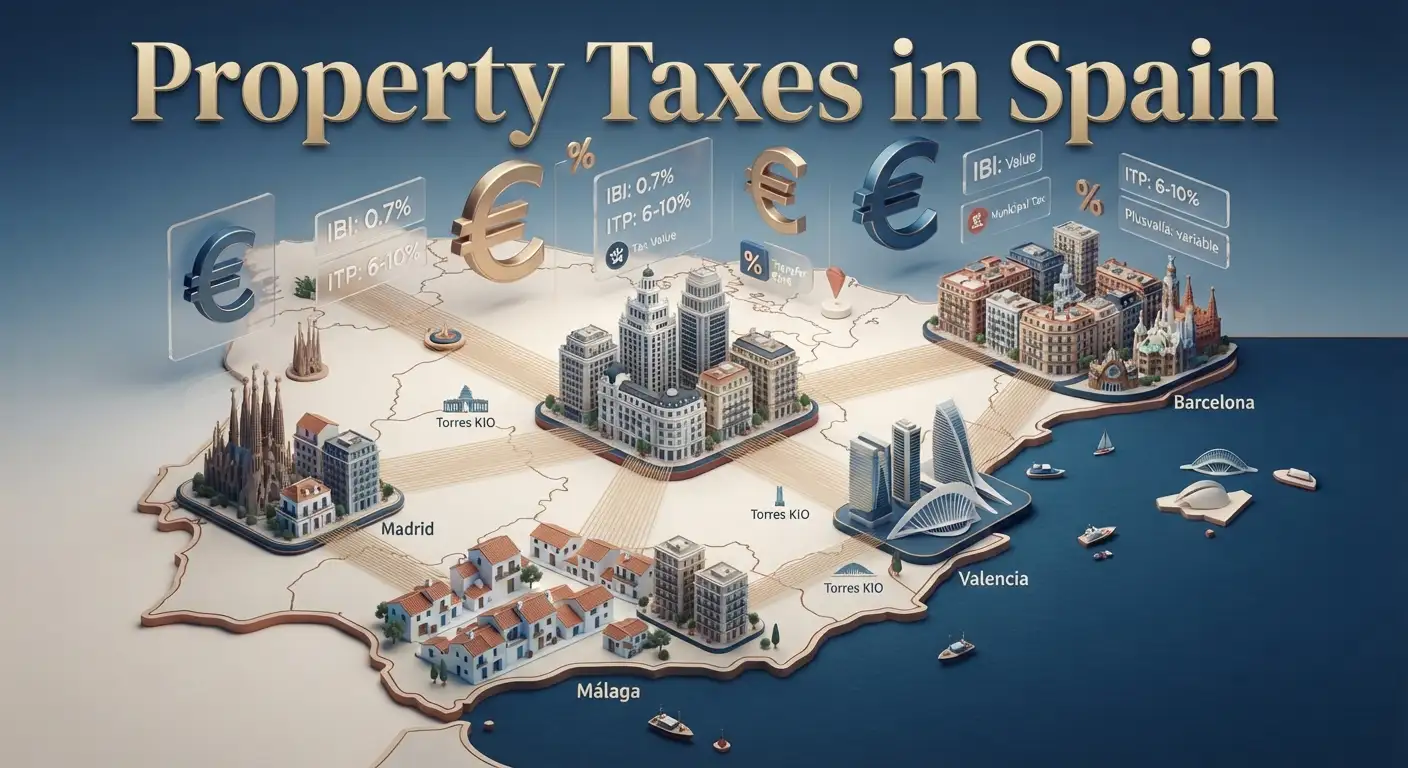
Property taxation touches buyers, owners, landlords, and sellers differently, and much of this ground overlaps with Investing in Spain article’s real estate investment coverage. Here it’s organized specifically around the property lifecycle, since taxes apply at genuinely different moments and under different rules at each stage.
Buying: Transfer Tax (ITP), VAT on New Builds, Stamp Duty
What you pay when buying depends on whether the property is new or resale:
| Property Type | Applicable Tax | Typical Rate |
|---|---|---|
| Resale property | ITP (Property Transfer Tax) | 6% to 13%, regional |
| New build | VAT (IVA) + AJD (stamp duty) | 10% VAT + 0.5% to 1.5% AJD |
ITP rates vary meaningfully by autonomous community, with Andalusia applying a flat 7% and Catalonia running progressive up to 13%. It’s always worth confirming the current regional rate before signing, since these figures shift with regional budgets.
Owning: Annual Property Tax (IBI), Non-Resident Property Tax
Simply owning Spanish property triggers two recurring annual obligations:
- IBI, the local municipal property tax, billed annually by the town council based on the property’s cadastral value
- Non-resident imputed income tax, filed through Modelo 210, applying a notional taxable income to any property not actually rented out, based on the cadastral value
This second tax often surprises non-resident owners who use their property purely as a personal holiday home. Even without any rental income, Spain still taxes the property as if it generated a small imputed benefit simply by being owned and available.
Rental Income Tax (Residents and Non-Residents)
Rental income tax treatment splits sharply by residency status, echoing the pattern seen throughout this guide:
- Spanish residents: rental income is folded into general IRPF income, taxed at progressive rates, with a 50% reduction available on long-term residential lease income
- EU/EEA non-residents: flat 19% on rental income, also benefiting from the 50% deduction on eligible expenses
- Non-EU non-residents: flat 24%, generally applied to gross rental income without the expense deduction available to EU owners
That gap between EU and non-EU rental income tax treatment is one of the more consequential post-Brexit changes for British property owners specifically, who lost access to certain EU-specific deductions and now face the less favorable non-EU treatment on rental income, even while retaining the more favorable 19% rate on capital gains under the UK-Spain tax treaty.
Selling: Capital Gains and Tax Obligations
Selling triggers capital gains tax based on residency (progressive for residents, flat 19% or 24% for non-residents), alongside the mandatory 3% withholding the buyer deducts and remits on the seller’s behalf. Sellers then have four months to file the final reconciliation through Modelo 210, either settling any remaining balance or reclaiming an overpayment if the withholding exceeded the actual liability.
Wealth Tax and the Solidarity Tax
Spain remains one of the few EU countries still levying an annual tax on net wealth itself, not just income or gains, and this section revisits it specifically from a general tax-obligation perspective.
Who Has to Pay Wealth Tax
Wealth tax (Impuesto sobre el Patrimonio) applies differently depending on residency:
| Scope of Taxation | |
|---|---|
| Spanish tax residents | Worldwide net assets |
| Non-residents | Spanish-situated assets only |
A general €700,000 exemption applies nationally per individual, plus an additional €300,000 exemption for a primary residence, available to qualifying residents specifically. Rates are progressive, generally ranging from 0.2% to 3.5%, though regional bonifications can significantly reduce or even eliminate the effective burden depending on where you’re based.
Wealth Tax for Foreigners
Foreign residents and non-residents alike fall under this system the moment they hold qualifying Spanish assets above the relevant threshold. A few points worth flagging specifically:
- Non-resident property owners, even those who never live in Spain, can owe wealth tax purely on their Spanish real estate
- Regional variation matters enormously; Madrid offers close to full bonification, while other regions apply the standard scale in full
- A recent Supreme Court ruling extended certain tax-limiting protections to non-residents as well, worth reviewing with an advisor if you’ve been paying this tax for several years
Solidarity Tax on Large Fortunes
Layered on top of standard wealth tax is the Solidarity Tax on Large Fortunes, a national tax applying to net wealth exceeding €3,000,000, designed specifically to prevent high-net-worth individuals from avoiding wealth tax entirely by relocating to a favorably bonified region.
Think of it as a national floor beneath the regional system. Wealth tax already paid at the regional level is credited against this national tax, so it’s not true double taxation, but it does mean high-net-worth individuals can’t simply choose a low-tax region and avoid meaningful wealth taxation altogether.
For high-net-worth foreign residents specifically, this combination of regional wealth tax and the national solidarity tax floor makes proactive tax planning, ideally well before establishing Spanish residency, considerably more valuable than reactive filing once thresholds are already crossed.
Inheritance and Gift Tax
Inheritance and gift tax (Impuesto sobre Sucesiones y Donaciones) is genuinely one of the more surprising parts of Spanish tax law for foreigners, largely because it works so differently from the estate tax systems many people are used to.
Spanish Inheritance Tax
Unlike the UK or US, where the estate itself pays tax before distribution, Spain taxes each individual heir separately, based on what they personally receive. State-level rates range from 7.65% to 34% before regional adjustments, but that headline range tells you very little on its own, since the regional layer is where the real numbers get decided.
Heirs are grouped by relationship to the deceased, with closer relatives receiving significantly better treatment:
| Group | Relationship | Typical Treatment |
|---|---|---|
| Group I | Children under 21 | Most favorable allowances |
| Group II | Spouse, children over 21, parents, grandchildren | Most favorable allowances |
| Group III | Siblings, aunts, uncles, nieces, nephews | Reduced allowances, higher rates |
| Group IV | Unrelated beneficiaries | Least favorable treatment |
Spanish Gift Tax
Gift tax operates under the same underlying framework as inheritance tax, sharing the same rate structure and regional variation, but applying to lifetime transfers rather than transfers after death. This makes gifting during one’s lifetime a genuine planning tool in some regions, since gifts can sometimes be structured at more favorable rates than waiting for inheritance, though the rules here are detailed enough to warrant professional guidance rather than DIY planning.
Inheritance Tax for Foreigners
Here’s where regional variation becomes genuinely dramatic:
- Madrid: close relatives (Groups I and II) benefit from a 99% reduction, effectively near-zero tax
- Andalusia: a €1,000,000 per-heir allowance plus 99% reduction above that threshold, making it one of Spain’s most favorable regions
- Balearic Islands: effectively 100% relief for Groups I and II
- Canary Islands: 99.9% reduction, practically eliminating the tax for spouses and children
- Catalonia: no equivalent blanket reduction; a comparable estate could owe €15,000 to €25,000 in tax where Madrid or Andalusia would owe close to nothing
The same €500,000 inheritance can produce a wildly different tax bill depending purely on which autonomous community applies, not on the heir’s wealth or circumstances. Since 2015, non-residents inheriting Spanish assets can generally choose to apply the most favorable regional rules connected to the case, rather than being stuck with a less favorable default, which makes understanding this regional layer genuinely worth doing before, not after, a loss occurs.
A few additional practical points:
- Non-residents are taxed only on Spanish-situated assets; residents face worldwide inheritance taxation
- Filing and payment is due within 6 months of death, with a possible 6-month extension if requested before month five
- There’s no double taxation treaty covering inheritance tax between Spain and most countries, including the UK, though unilateral credit relief generally prevents true double taxation on the same asset
Given how much this outcome depends on region, relationship, and timing, inheritance and gift tax planning is genuinely one of the areas in this entire guide where getting professional advice well in advance, rather than leaving heirs to navigate it after the fact, makes a measurable difference.
Double Taxation and Tax Treaties
Moving income, assets, or yourself across borders naturally raises the question: could the same income get taxed twice? Spain’s extensive treaty network exists specifically to prevent that, and understanding how it works is genuinely useful for almost anyone covered throughout this guide.
How Double Taxation Agreements Work
Spain maintains double taxation treaties with over 90 countries, generally following the OECD Model Tax Convention. These treaties typically work through one of two mechanisms:
- Exemption method: income is taxed in only one country, with the other country exempting it entirely
- Credit method: income is taxed in both countries, but tax paid in one is credited against the liability owed in the other
Most treaties also include tie-breaker rules for residency, directly relevant to the dual-residency ambiguity flagged earlier in this guide, helping determine which country has primary taxing rights when someone could technically qualify as a tax resident in both.
Foreign Tax Credits
For Spanish tax residents with foreign-source income already taxed abroad, Spain generally allows a foreign tax credit, reducing the Spanish tax liability by the amount already paid overseas, up to the equivalent Spanish tax that would have applied to that same income. This prevents the same euro of income from being fully taxed twice, though the credit is typically capped rather than unlimited.
Avoiding Double Taxation as a Foreigner
A few practical points worth understanding:
- Withholding tax on dividends and interest is frequently reduced under treaty terms, sometimes to 15% or lower, rather than Spain’s standard 19% non-resident rate
- Inheritance tax is a notable exception; most Spanish tax treaties, including the one with the UK, don’t cover inheritance tax at all, relying instead on unilateral relief mechanisms rather than treaty protection
- US citizens face a particularly layered situation, since citizenship-based US taxation applies regardless of Spanish residency, making the interaction between the two systems worth planning carefully with an advisor familiar with both
Treaty relief generally isn’t automatic. In many cases, you need to actively claim it, whether through your broker, employer, or a direct filing, rather than assuming the lower rate applies by default. Confirming exactly how relief gets applied in your specific situation, before assuming you’re covered, avoids paying more than necessary and having to reclaim it later.

The Beckham Law: Special Tax Regime for Foreigners
Referenced throughout this series, the Beckham Law deserves its own full explanation here, since it’s genuinely one of the most valuable tax tools available to qualifying foreigners moving to Spain, and also one of the most misunderstood.
Who Qualifies
Officially the Special Expatriate Tax Regime (Article 93 of the IRPF Law), the Beckham Law requires meeting all of the following conditions:
- No Spanish tax residency in any of the previous 5 tax years
- A move to Spain triggered by a qualifying reason: an employment contract, intra-company transfer, company directorship, startup entrepreneurship under the Startup Law, highly qualified professional/R&D activity, or remote work under the Digital Nomad Visa
- No income from a Spanish permanent establishment, with limited exceptions
- At least 85% of work duties performed in Spain (or 70% if providing services to a related company within the same corporate group)
- Application filed within 6 months of Social Security registration or arrival, whichever comes first
That final deadline is strictly enforced and cannot be extended for any reason. Missing it by even a single day means paying Spain’s standard progressive rates, up to 47%, for the entire period of Spanish residence, with no way to fix it retroactively. This is genuinely the single most common reason otherwise-qualified applicants lose access to the regime.
Requirements and Tax Rates
Once approved, the regime offers meaningfully favorable treatment:
| Feature | Detail |
|---|---|
| Tax rate on income up to €600,000 | Flat 24% |
| Tax rate above €600,000 | 47% |
| Duration | Year of arrival plus up to 5 additional years (6 total) |
| Scope of taxation | Spanish-sourced income only; most foreign income generally exempt |
| Application form | Modelo 149 |
Beckham Law for Digital Nomads
Digital Nomad Visa holders working as remote employees for a foreign company generally satisfy the regime’s qualifying trigger cleanly, and it’s genuinely worth electing in almost every case: the effective break-even point sits around €42,000 in annual income, which happens to closely track the visa’s own minimum income threshold, meaning most eligible digital nomads come out ahead.
Here’s the important nuance worth flagging clearly: freelancers and most self-employed autónomos are generally excluded from the Beckham Law, since registering as self-employed in Spain is typically treated as creating a Spanish permanent establishment, which disqualifies the regime under condition three above. If you’re a freelancer on the Digital Nomad Visa rather than a remote employee, this is genuinely worth confirming with a specialist before assuming eligibility, since the visa itself doesn’t automatically grant the tax regime.
Beckham Law for Entrepreneurs
Since the 2023 Startup Law reform, founders launching a qualifying innovative company in Spain, along with highly qualified professionals working on approved R&D projects, gained expanded access to the regime beyond the traditional employee-only framework. This connects directly to the Entrepreneur Visa, since many founders using that visa route can now also access Beckham Law treatment, provided the startup itself qualifies under Startup Law criteria.
How to Apply
The application process runs through Modelo 149, filed with the Spanish Tax Agency within the strict 6-month window described above. Given how unforgiving that deadline is, and how much value is at stake, most applicants work with a Spanish tax advisor from the moment they register with Social Security, rather than waiting until the paperwork feels urgent.
Beckham Law vs Ordinary Tax Regime
The comparison ultimately comes down to income level and structure:
- Higher earners (roughly above €40,000 to €50,000 annually) generally benefit significantly, since the flat 24% rate beats standard IRPF’s climb toward 45 to 47%
- Freelancers and autónomos, for the most part, simply can’t access this comparison at all under current rules, and remain on standard IRPF or need to explore whether they qualify under the narrower startup entrepreneur pathway instead
- Lower earners may find the ordinary regime’s personal allowances and deductions, covered earlier in this guide, actually produce a comparable or occasionally better outcome, worth modeling both ways before assuming the Beckham Law automatically wins
Taxation of Digital Nomads in Spain
This section pulls together everything relevant to Digital Nomad Visa holders specifically, connecting Spain Digital Nomad Visa article’s visa coverage with the tax mechanics detailed throughout this guide.
Digital Nomad Visa Tax Rules and Rates
Digital nomads generally fall into one of two tax situations, and which one applies depends heavily on employment structure:
- Remote employees of foreign companies typically qualify for the Beckham Law, covered in the previous section, giving access to the flat 24% rate up to €600,000 for up to 6 years
- Freelancers and self-employed digital nomads generally do not qualify for the Beckham Law, since self-employment is typically treated as creating a Spanish permanent establishment, and instead fall under standard progressive IRPF rates once they become tax resident
This distinction matters enormously and is worth confirming individually rather than assuming, since it’s easy to conflate “holding a Digital Nomad Visa” with “qualifying for the Beckham Law.” They’re related but genuinely separate questions.
Tax Residency for Digital Nomads
As covered earlier in this guide, crossing 183 days of physical presence in Spain within a calendar year, or meeting the economic center of interest or family presumption tests, triggers Spanish tax residency regardless of visa type. Once resident, worldwide income generally comes into scope, modified favorably for those who successfully elect the Beckham Law.
Taxation of Foreign Remote Work Income
For Beckham Law-eligible remote employees, foreign-sourced income is generally exempt from Spanish taxation, with only Spanish-sourced income taxed at the flat 24% rate. This is a genuinely significant advantage, since it means salary paid by a foreign employer, taxed as Spanish-sourced for Beckham Law purposes because the work is physically performed in Spain, faces the flat rate, while other unrelated foreign income streams may fall outside Spanish tax entirely.
For those who don’t qualify for the Beckham Law, worldwide income (including that same foreign salary) becomes fully taxable under standard progressive IRPF once Spanish tax residency is established.
Freelancers on the Digital Nomad Visa
Given the Beckham Law exclusion, freelancers on this visa need a slightly different tax planning approach:
- Register as autónomo under RETA, once resident
- File quarterly IRPF advances (Modelo 130) and VAT returns (Modelo 303) as detailed earlier in this guide
- Pay standard progressive IRPF rates on net profit at annual filing
- Apply the standard business expense deductions available to any autónomo to reduce taxable profit
Freelance digital nomads sometimes assume the visa itself carries the same tax advantage as the employee route. It doesn’t automatically. If minimizing tax exposure is a genuine priority and your situation allows flexibility in how you’re structured, whether as an employee of your own foreign company or in some other qualifying arrangement, it’s worth exploring with a specialist before assuming standard IRPF is your only option.

Reporting Foreign Assets and Cryptocurrency
Spanish tax residents with assets abroad face reporting obligations distinct from any tax actually owed. These are informative declarations, not tax bills in themselves, but the penalties for missing them can be significant.
Tax on Foreign Bank Accounts, Investments and Property
Spanish tax residents are taxed on worldwide income and assets, meaning foreign bank interest, foreign investment gains, and foreign rental income all fall within Spanish IRPF scope, alongside potential wealth tax exposure on the underlying assets themselves once the relevant thresholds are crossed.
Modelo 720: Declaring Foreign Assets
Modelo 720 requires Spanish tax residents to declare foreign assets exceeding €50,000 in any of three separate categories:
| Category | Threshold Basis |
|---|---|
| Foreign bank accounts | 31 December balance or Q4 average, whichever is higher |
| Foreign securities and investments | Value as of 31 December |
| Foreign real estate | Acquisition cost, not current market value |
Each category is assessed independently, so only categories individually exceeding €50,000 trigger the obligation. Filing runs January 1 to March 31 each year. Once filed, you generally only need to refile if a category’s value increases by more than €20,000, or if a new reportable asset appears.
A property bought years ago for €60,000, now worth only €45,000, still triggers the filing requirement, since the threshold is measured against what you paid, not current market value. This surprises more people than any other detail of this form.
Modelo 721: Declaring Crypto Held Abroad
Cryptocurrency has its own dedicated form, separate from Modelo 720 entirely. Modelo 721 requires Spanish tax residents to declare cryptocurrency held on foreign platforms exceeding €50,000 in aggregate value as of 31 December, covering both foreign exchanges and self-custodied wallets. A few key distinctions:
- Crypto held on a Spanish-registered exchange doesn’t need Modelo 721, since the exchange reports it directly
- Only foreign-platform holdings (Binance, Coinbase, Kraken, and similar) trigger the obligation
- The same January to March filing window and €20,000 increase refiling rule apply, mirroring Modelo 720
Penalties for late or incorrect filing are notably lighter than Modelo 720’s original regime (following an EU court ruling that struck down its previously disproportionate penalties), but they still apply: €200 for missing the deadline, €150 for filing incorrectly.
Cryptocurrency Tax in Spain
Beyond the reporting obligation, actual crypto gains face standard tax treatment:
- Spain classifies cryptocurrency as a digital asset, similar to shares, not as currency
- Every disposal, selling for fiat, crypto-to-crypto trades, and certain DeFi transactions, generally triggers a taxable event under the same savings income scale covered earlier (19% to 30%)
- Staking and lending rewards are generally treated as capital income, while mining or business-like crypto activity can instead fall under standard business income rules
- Crypto holdings also count toward wealth tax thresholds where applicable, valued in euros as of 31 December
Given how actively the Spanish tax agency now tracks crypto activity, through exchange reporting and EU-wide data-sharing rules, treating these obligations as optional or low-risk is a genuinely costly assumption. Anyone holding meaningful crypto assets abroad while Spanish tax resident should treat Modelo 721 and proper capital gains reporting as a standard annual task, not an afterthought.
Non-Resident Tax in Spain (IRNR)
While much of this guide focuses on residents, a significant number of foreigners with ties to Spain never actually become tax residents at all. For them, an entirely separate system applies: IRNR, Spain’s non-resident income tax.
Who Pays Non-Resident Income Tax
Anyone earning Spanish-sourced income without meeting Spain’s residency tests (covered earlier in this guide) falls under IRNR rather than standard IRPF. This includes:
- Property owners who don’t live in Spain
- Investors holding Spanish shares, bonds, or funds from abroad
- Business owners with Spanish company income who remain tax resident elsewhere
- Anyone earning occasional Spanish-sourced income without establishing residency
The core distinction, worth repeating from earlier in this guide, is scope: residents are taxed on worldwide income; non-residents only on Spanish-sourced income.
Non-Resident Property Tax
Simply owning Spanish property as a non-resident triggers recurring obligations regardless of whether the property generates any income:
- IBI, the annual local municipal property tax, applies identically to residents and non-residents
- Imputed income tax, filed through Modelo 210, applies a notional taxable income to any property not actually rented out, based on the cadastral value
This second obligation catches many non-resident owners off guard, particularly those using a Spanish property purely as an occasional holiday home. Spain still taxes it as if it generated a small benefit, simply by virtue of being owned and available for use.
Rental Income Tax for Non-Residents
As detailed in the property tax section earlier in this guide, rental income tax for non-residents splits by nationality:
| Owner Type | Rate | Expense Deduction |
|---|---|---|
| EU/EEA non-resident | 19% | Yes, expenses deductible |
| Non-EU non-resident | 24% | No, tax applies to gross income |
This gap is one of the more consequential post-Brexit changes for British property owners specifically, who moved from the more favorable EU treatment to the flat 24% non-deductible rate.
Property Sales Tax for Non-Residents
When a non-resident sells Spanish property, two mechanisms apply together:
- The buyer withholds 3% of the total sale price, remitted directly to the tax authorities as an advance payment
- The seller then has four months to file the final capital gains declaration through Modelo 210, at a flat 19% (EU/EEA) or 24% (non-EU) rate on the actual gain, either paying any balance owed or reclaiming the difference if the withholding exceeded the final liability
Non-resident sellers should treat the 3% withholding as a genuine cash flow event, not just a paperwork step. Even when the final tax bill turns out lower than the amount withheld, refunds from the tax agency can take considerably longer to process than the sale itself, so budgeting for that gap in timing matters in practice.
Moving to or Leaving Spain: Tax Implications
Both directions of this journey trigger their own specific tax events, and each is worth understanding before it happens, not after.
Becoming a Resident
Arriving and establishing Spanish tax residency, as covered earlier in this guide, generally shifts your tax exposure from Spanish-sourced income only to worldwide income. A few practical steps worth handling proactively:
- Determine in advance whether you’ll cross the 183-day threshold, or trigger residency through the economic center of interest or family presumption tests
- Assess Beckham Law eligibility before arrival, since the application clock starts from Social Security registration, not from when you get around to filing
- Understand what foreign asset reporting (Modelo 720 and 721, covered earlier) will apply once you become resident
Leaving Spain
Departing residents generally need to file a final Spanish tax return covering income up to the date residency ends, and formally notify the tax authorities of the change. For most people, this is a relatively routine process. For a specific group of higher-net-worth individuals, it triggers something considerably more significant.
Exit Tax
Spain’s exit tax (Impuesto de Salida, under Article 95 bis of the IRPF law) treats departure itself as a deemed disposal of certain shareholdings, taxing unrealized gains as if the shares had actually been sold on your last day of Spanish residency. It’s genuinely a niche provision, most people leaving Spain, including the large majority of freelancers, autónomos, and small business owners, fall well below its thresholds.
The tax applies only if you meet one of two tests:
- Total unrealized gains across all shareholdings exceed €4,000,000
- You hold at least 25% of a single company, and that stake’s value exceeds €1,000,000
Where it applies, the calculated unrealized gain is taxed at Spain’s standard savings income rates (19% to 28%). Genuine relief exists for those moving within the EU or EEA: deferral is generally available until the shares are actually sold, rather than requiring immediate payment on departure. Moving outside the EU typically requires payment upfront.
This is squarely a high-net-worth consideration, not something the typical Digital Nomad Visa holder or small autónomo needs to worry about. But for entrepreneurs who’ve built genuinely significant equity in a Spanish or Spanish-linked company, this is exactly the kind of provision worth mapping out years before an eventual departure, not discovering during the exit itself.
Tax Guides by Nationality
While most of this guide applies universally to foreign residents, a few nationality-specific quirks are significant enough to flag directly here, with full dedicated guides linked separately for each.
American Expats
US citizens face a genuinely unique layer on top of everything else in this guide: citizenship-based taxation. Unlike almost every other country, the US taxes its citizens on worldwide income regardless of where they live, meaning American expats in Spain must file both Spanish and US tax returns every year, even while fully compliant with Spanish tax obligations.
Key considerations:
- The US-Spain tax treaty and Foreign Tax Credit generally prevent true double taxation, though the mechanics require careful coordination between both systems
- FBAR and FATCA reporting obligations apply to US citizens holding foreign accounts, layered on top of Spain’s own Modelo 720 requirements covered earlier
- Beckham Law interaction with US tax rules requires specialist review, since the regime’s benefits don’t automatically translate into equivalent US tax relief
UK Citizens
Since Brexit, UK citizens are treated as non-EU nationals for most Spanish tax purposes, a meaningful shift from the more favorable treatment UK nationals received pre-2020:
| Area | Pre-Brexit | Current Treatment |
|---|---|---|
| Non-resident rental income | 19%, expenses deductible | 24%, generally no deductions |
| Non-resident capital gains | 19% | Still 19%, per UK-Spain treaty |
| Inheritance tax (IHT) | N/A | No UK-Spain treaty coverage; unilateral relief only |
The gap between rental income treatment (worse for UK non-residents) and capital gains treatment (still favorable, per treaty) surprises many British property owners, who assume Brexit affected every tax uniformly. It didn’t.
Canadian Citizens
Canadians benefit from a long-standing Canada-Spain double taxation treaty, generally following the standard credit-method relief covered earlier in this guide. Canadian pension income and investment income each carry their own treaty-specific treatment worth reviewing individually, particularly for retirees considering the retirement planning.
EU Citizens
EU citizens benefit from the most straightforward tax position covered in this guide: free movement rights, no non-resident penalty rates on property income, and generally the most favorable available rates across rental income, capital gains, and dividend withholding wherever residency status doesn’t yet apply.
Non-EU Citizens
Beyond the US, UK, and Canada, non-EU citizens generally fall under the standard IRNR framework covered throughout this guide (24% rental and dividend rates, no expense deductions on rental income), though many countries maintain their own specific double taxation treaties with Spain worth checking individually, since treaty relief varies considerably by country rather than applying uniformly to all non-EU nationals.
Taxation of Pensioners and Retirees
Spain remains a genuinely popular retirement destination, and pension taxation follows its own specific rules worth understanding separately from employment or investment income.
Tax on Foreign Pensions
Once Spanish tax resident, foreign pension income generally becomes taxable in Spain as part of worldwide income, though how it’s classified matters:
- Private and occupational pensions are typically taxed as general employment-type income under standard progressive IRPF rates
- Government or public service pensions are often treated differently under specific double taxation treaty provisions, sometimes remaining taxable only in the country of origin rather than in Spain
- Relief under the relevant tax treaty, covered earlier in this guide, generally prevents the same pension income from being fully taxed twice
Taxation of Retirement Income
Beyond pensions specifically, retirees living in Spain typically combine several income sources, investment income, rental income, and pension payments, each taxed under its own set of rules already covered throughout this guide. A few practical points for retirees specifically:
- The Non-Lucrative Visa, is the most common route for retirees without earned income, but doesn’t itself change how pension or investment income is taxed once resident
- Beckham Law generally doesn’t apply to pure retirement income, since it requires a qualifying employment or business-related trigger
- Wealth tax exposure becomes genuinely relevant for retirees with significant accumulated assets, worth reviewing well before relocating rather than after establishing residency
Given how many different income streams typically converge for retirees, this is an area where a coordinated tax plan, covering pensions, investments, and property together, tends to produce meaningfully better outcomes than handling each piece separately.
Tax Obligations for Families
Family structure genuinely affects how Spanish tax works, from filing choices to specific allowances built into the system for dependents.
Married Couples: Joint vs Individual Returns
Spanish tax residents who are married can choose between filing individually or jointly, and the right choice depends heavily on the income gap between spouses:
| Filing Type | Best For |
|---|---|
| Joint return | Households with one significantly higher earner, or one non-working spouse |
| Individual returns | Couples with relatively similar, higher individual incomes |
Joint filing applies a single, larger personal allowance to combined income rather than each spouse claiming their own separately, which can genuinely help when income is concentrated with one partner, but often works against couples with two solid, comparable incomes, since it can push more combined income into higher brackets than filing separately would.
There’s no universal right answer here. It’s genuinely worth calculating both ways each year, since a couple’s optimal filing status can shift as income levels change.
Taxation of Children and Dependents
Dependent children themselves generally don’t owe tax on modest amounts, but they factor into the family’s overall tax position through specific allowances:
- Family allowances apply per dependent child under 25 living in the household, covered earlier in this guide’s IRPF section: €2,400 for the first child, rising for additional children
- Children with their own independent income above certain thresholds may need to file separately rather than being claimed as a dependent
- Childcare and education costs carry limited, specific deductions in some regions, varying by autonomous community
Tax Benefits for Families
Beyond the core family allowance, several regions offer additional family-specific benefits worth checking locally:
- Large family status (familia numerosa), generally three or more children, unlocks additional regional tax reductions and benefits in many communities
- Some regions offer enhanced deductions for childcare expenses, school costs, or large family housing purchases
- Family circumstances can also affect wealth tax exemptions and inheritance tax allowances, both covered earlier in this guide
Given how much regional variation affects family-specific benefits specifically, it’s worth checking your particular autonomous community’s current family tax incentives directly, since these tend to change more frequently than the national-level rules covered elsewhere in this guide.
Tax Planning: Reducing Your Tax Bill and Avoiding Mistakes
Everything covered so far in this guide describes how Spanish tax works. This section is about using that knowledge deliberately, and avoiding the mistakes that cost foreigners the most, year after year.
Legal Ways to Reduce Taxes
A few genuinely effective, fully legal strategies worth considering:
- Elect the Beckham Law where eligible, covered in full earlier in this guide, since the flat 24% rate often beats standard IRPF significantly for higher earners
- Choose your region deliberately where you have flexibility, given how much wealth tax, ITP, and inheritance tax vary between Madrid, Andalusia, and less favorable regions like Catalonia
- Maximize pension contributions, deductible up to the annual limits covered earlier
- Time asset sales strategically, since capital gains brackets are progressive, spreading large disposals across tax years can reduce the marginal rate applied
- Use the ETVE holding structure for larger international investment portfolios routed through Spain
Tax-Efficient Planning for Expats
Beyond general strategies, a few considerations apply specifically to foreigners navigating Spain’s system for the first time:
- Plan Beckham Law eligibility before arrival, not after, since the 6-month application window starts from Social Security registration
- Coordinate double taxation treaty relief proactively rather than overpaying and reclaiming later
- Structure business income deliberately between autónomo and company status, revisiting the comparison covered in Spain Digital Nomad Visa article as income grows
- Account for citizenship-based tax obligations early if you’re American, given the dual-filing reality covered earlier in this guide
The single biggest planning advantage available to any foreigner moving to Spain is timing. Nearly every favorable option in this guide, Beckham Law, regional residency choice, treaty coordination, works better when planned before the move than adjusted after arrival.
Common Tax Mistakes Foreigners Make
Recurring patterns worth avoiding:
- Missing the Beckham Law’s 6-month deadline, the single most common and most costly error covered in this entire guide
- Assuming a visa automatically grants a tax status, when in fact visa and tax regime are always separate questions
- Ignoring foreign asset reporting (Modelo 720 and 721), assuming previously-taxed foreign assets don’t need declaring in Spain
- Underestimating regional tax variation, particularly wealth tax and inheritance tax, when choosing where to settle
- Filing quarterly obligations late as a new autónomo, triggering avoidable surcharges
Hiring a Tax Advisor
Given how much of this guide hinges on residency status, regional variation, and strict deadlines, most foreigners in Spain work with a professional, at least for their first filing.
How to Choose One
A few practical criteria worth prioritizing:
- Experience specifically with foreign clients, not just general Spanish tax work
- Familiarity with your specific situation (Beckham Law, US citizenship, self-employment, or investment-heavy portfolios each require different expertise)
- Clear communication in a language you’re comfortable working in for something this consequential
Typical Costs
| Service Level | Typical Annual Cost |
|---|---|
| Basic autónomo quarterly filing | €50 to €150/month |
| Standard resident income tax return | €100 to €300 (one-time) |
| Beckham Law application and ongoing filing | €500 to €1,500+ |
| Comprehensive planning (investments, wealth tax, cross-border) | Varies significantly by complexity |
For most straightforward situations, a competent gestor is entirely sufficient. For anything involving the Beckham Law, US citizenship, significant investments, or wealth tax exposure, the cost of a specialist tax advisor is, in nearly every case covered throughout this guide, considerably smaller than the cost of getting it wrong.
Tax Calendar and Key Forms
With every major tax topic now covered, it’s useful to pull the recurring deadlines and forms mentioned throughout this guide into one consolidated reference.

Annual Tax Calendar for Foreigners
| Period | Obligation |
|---|---|
| January 1 to March 31 | Modelo 720 (foreign assets) and Modelo 721 (foreign crypto) filing |
| Quarterly (Jan, Apr, Jul, Oct) | Modelo 130 (IRPF advance) and Modelo 303 (VAT) for autónomos |
| April 1 to 20 | Non-resident rental income tax filing, per 2026 deadline updates |
| April to June 30 | Annual income tax return (Modelo 100), or Modelo 151 for Beckham Law filers |
| Within 6 months of registration | Beckham Law application (Modelo 149), strict and non-extendable |
| Within 4 months of a property sale | Capital gains reconciliation (Modelo 210) |
| Annually, if applicable | Wealth tax and Solidarity Tax filings |
| Within 6 months of death | Inheritance tax filing, extendable by 6 more months if requested in time |
It’s worth noting that Spain has recently adjusted several non-resident filing windows, so confirming the current year’s exact dates directly with a gestor or the Agencia Tributaria’s own calendar is always safer than relying on a fixed date carried over from a previous year.
Spanish Tax Forms and Modelo Numbers (Quick Reference)
| Form | Purpose |
|---|---|
| Modelo 030 | Tax registration (initial NIF/NIE activation) |
| Modelo 036/037 | Business census declaration |
| Modelo 100 | Annual income tax return (residents) |
| Modelo 130 | Quarterly IRPF advance (autónomos) |
| Modelo 149 | Beckham Law application |
| Modelo 151 | Annual return for Beckham Law filers |
| Modelo 210 | Non-resident income tax (rental, imputed, capital gains) |
| Modelo 303 | Quarterly VAT return |
| Modelo 390 | Annual VAT summary |
| Modelo 714 | Wealth tax return |
| Modelo 720 | Foreign asset reporting |
| Modelo 721 | Foreign cryptocurrency reporting |
Bookmarking this table, or keeping it alongside whichever gestor or advisor manages your filings, tends to save real time across the year, since Spain’s system involves considerably more distinct forms than most foreigners expect when they first become tax resident.
Frequently Asked Questions
Do I need to file a Spanish tax return if I earned less than €1,000 that year?
Generally no. Article 96 of the IRPF law exempts taxpayers from filing if their total income from work, capital, and economic activities, combined with any capital gains, falls below €1,000 for the year.
Can I get a refund if too much tax was withheld from my Spanish salary?
Yes. If your employer’s withholding throughout the year exceeds your actual final IRPF liability, the difference is refunded automatically when you file your annual return.
Does divorce affect my tax residency or filing status in Spain?
Yes. Divorce ends the option to file jointly as a married couple, and depending on custody arrangements, it can also affect which parent claims certain child-related allowances going forward.
Can I deduct mortgage interest on a property in my home country from my Spanish taxes?
Generally not under current rules, since Spain removed the mortgage interest deduction for properties purchased after 2013, and this applies regardless of whether the property is in Spain or abroad.
What happens to my tax obligations if I work in Spain for a short project, less than 183 days?
You’d generally remain a non-resident and be taxed only on the Spanish-sourced income from that specific work, under the IRNR system rather than full IRPF.
Are lottery and gambling winnings taxed in Spain?
Yes, though certain state lottery winnings benefit from a specific exemption on the first portion won, with the remainder taxed at a fixed rate separate from the standard IRPF scale.
Can I pay my Spanish taxes from a foreign bank account?
Yes, though direct debit for quarterly and annual filings generally requires a Spanish (or SEPA-zone) bank account, so most foreigners set up local banking specifically for this purpose.
Does owning a Spanish company affect my personal tax residency status?
Not automatically. Company ownership alone doesn’t trigger personal tax residency, though it can factor into the “economic center of interest” test if your primary business activity is genuinely based in Spain.
Is there a statute of limitations on unpaid Spanish taxes?
Yes, generally four years from the filing deadline, after which Hacienda can no longer pursue a standard assessment, though this period can be extended in cases involving fraud or where filings were never submitted at all.
Can I change tax advisors partway through a Spanish tax year without complications?
Yes, though it’s worth ensuring a clean handover of documentation and confirming no filings fall through the gap between advisors, since responsibility for missed deadlines remains with the taxpayer regardless of who was managing the filing.
Summary
Spain’s tax system genuinely rewards those who plan ahead and penalizes those who don’t, sometimes significantly. A few themes worth carrying forward:
- Residency status decides everything: worldwide taxation for residents, Spanish-source only for non-residents
- Regional variation is real: wealth tax, ITP, and inheritance tax can differ dramatically between Madrid, Andalusia, and less favorable regions
- The Beckham Law is powerful but strict: a genuinely valuable flat 24% rate, guarded by an unforgiving 6-month deadline
- Reporting obligations aren’t optional: Modelo 720 and 721 apply regardless of whether foreign assets were already taxed elsewhere
- Nationality adds complexity: American citizenship-based taxation and post-Brexit UK treatment both require specialist attention
Whatever your situation, the consistent lesson throughout this guide is that professional tax planning, ideally before relocating rather than after, consistently pays for itself many times over.