What if you could open a business with a recognized brand, a tested operating model and a team that has already solved the problems most start-ups face? For many international investors, a franchise offers a middle path between building a company from scratch and buying an existing one. But is a famous name enough to guarantee a profitable outlet in Valencia, Madrid or Málaga? And how do you tell a strong franchisor from one that simply sells an attractive brochure?
Then come the questions that decide the outcome. How much will you really invest once the entry fee, shop fit-out, royalties and working capital are added up? What does the franchise contract promise, and what does it quietly restrict? Can a foreigner open a franchise in Spain, and what do you need to organize before signing?
Whether you dream of a café, a fitness studio, a retail store or a service brand, the steps you take before signing the contract shape your results for years. This guide walks you through the process, one clear step at a time. And when you want the complete picture of the sector, our pillar guide, Franchising in Spain, is the natural next stop.
Can Foreigners Buy a Franchise in Spain?
Yes. Spain places no general nationality or residency requirement on franchisees, so a foreign investor can sign a franchise agreement and operate an outlet on the same legal basis as a Spanish citizen. The franchise is a commercial contract between two independent businesses, which means the real questions are practical: how you will hold the business (as an autónomo or through a company), whether you can legally work in it, and whether the activity requires a local licence.
EU/EEA Investors
EU and EEA citizens can open a franchise with very few extra formalities. You need an NIE (Número de Identidad de Extranjero) for tax purposes, and you can register as self-employed (autónomo) or incorporate a Sociedad Limitada (SL) to operate the outlet. Freedom of movement lets you live and work in Spain without a separate work permit.
Non-EU Investors
Non-EU investors can sign the contract just as freely, but buying a franchise does not give you the right to live or work in Spain. If you plan to run the outlet yourself, you need a residence and work authorization, such as a self-employment residence permit, which generally requires a viability plan and sufficient funds. Solve the immigration route before paying any fee, since a franchise contract does not guarantee a visa.
How Does Franchising Work in Spain?
In a franchise, the franchisor grants you the right to use its brand, know-how and operating system in exchange for fees. You own and manage the outlet, hire the staff and assume the financial risk, while the franchisor provides training, supplier agreements, marketing and ongoing support. Spanish law regulates the activity through the Retail Trade Act (Ley de Ordenación del Comercio Minorista) and Royal Decree 201/2010, which requires franchisors to be registered in the Franchisor Registry (Registro de Franquiciadores) and to deliver precontractual information at least 20 days before signing or paying any amount.
How to Choose the Right Franchise in Spain
Compare opportunities against your goals, budget and experience rather than brand popularity alone.
Industry and Business Model
Choose a sector you understand or are willing to manage. Food service, retail, fitness, education, health and personal services are common categories, and each has different margins, staffing needs and sensitivity to seasonality. Decide whether you want a full-service outlet, a smaller format or a corner-store model, and check whether the franchisor allows a master franchise (rights over a whole region) if you plan to scale.
Investment Level and Expected Costs
Match the total investment to your available capital, including a reserve for the months before the outlet breaks even. Ask for a clear breakdown, since two franchises with the same entry fee can differ greatly once fit-out, equipment and stock are included.
Brand and Market Presence
A well-known brand in your home country may be unknown in Spain, and the reverse is also true. Look at how many outlets operate locally, whether the brand fits Spanish consumer habits and how strong the competition is in your target city.
How Much Does It Cost to Buy a Franchise in Spain?
Costs vary widely by sector and format, from a few thousand euros for a small service franchise to several hundred thousand for a restaurant or large store. The main items are:
| Cost | What It Covers |
|---|---|
| Entry fee (canon de entrada) | Right to join the network and use the brand |
| Royalties (canon de explotación) | Ongoing fee, often a percentage of sales or a fixed amount |
| Marketing fee | Contribution to national or regional advertising |
| Fit-out and equipment | Premises works, furniture and technology |
| Initial stock | Products required to open |
| Lease deposit and licences | Rental guarantee, activity licence and permits |
| Working capital | Cash for the first months of operation |
Confirm which fees are one-off and which are recurring, and whether you must buy supplies from the franchisor.
What Documents Should You Request From the Franchisor?
Ask for these documents and compare them with what the sales team says:
- Precontractual disclosure document with company data and trademark registration
- Franchisor Registry registration
- Draft franchise contract, including term, renewal and exit clauses
- Financial statements for recent years
- List of current and former franchisees
- Training, supplier and marketing details
- Territory or exclusivity terms
How to Evaluate a Franchise Before Buying
A strong brand does not guarantee a profitable outlet, so test the opportunity independently.
Reviewing Financial Information
Check the franchisor’s accounts and ask for the real performance of existing outlets, not only the projections. Build your own forecast with local rent, salaries and royalties, and calculate the break-even point.
Assessing the Franchise Network
Speak with several franchisees, including those who left the network. Ask about sales versus promises, support quality, supplier prices and how disputes were handled.
Checking the Franchisor’s Track Record
Review how long the franchisor has operated, how many outlets have opened and closed in recent years and whether the trademark is properly registered. For the full overview of the sector, see our pillar guide, Franchising in Spain. Because fees, regulations and deadlines change, have a Spanish lawyer verify the details before publishing.
What Is the Franchise Agreement in Spain?
The franchise agreement (contrato de franquicia) is the document that defines the whole relationship between you and the franchisor. Spanish law does not impose a single standard contract, so the terms are largely negotiated between the parties, within the limits of general contract law and competition rules. Read it as a business plan in legal form: it sets what you receive, what you pay, how long it lasts and how you can leave. Ask your lawyer to review the Spanish text, and request an official translation if you do not read Spanish fluently.
Franchise Fees and Royalties
The contract should state every payment clearly: the entry fee (canon de entrada), the recurring royalty (canon de explotación), the marketing contribution and any technology or training charges. Check how royalties are calculated, for example as a percentage of gross sales or as a fixed monthly amount, since a percentage of sales can weigh heavily on a low-margin outlet. Also confirm whether you must buy products or services from the franchisor or approved suppliers, and at what price.
Contract Duration and Renewal
Most agreements run for several years, often between three and ten, so compare the duration with the time you need to recover your investment. Review the renewal conditions, any renewal fee, the notice period and the consequences of early termination. Pay attention to post-contractual clauses, such as non-compete restrictions after you leave, which must remain reasonable in scope, time and territory under competition law.
Territory and Exclusivity
The contract should define your territory (zona de exclusividad) in precise terms, ideally with a map or a list of postal codes. Clarify whether the franchisor can open another outlet nearby, sell online within your area or use other sales channels. Without clear exclusivity, your outlet may compete with the brand itself.
What Legal Checks Should You Complete Before Signing?
Legal verification protects you from paying for a promise that cannot be delivered. Before signing, complete these checks:
- Franchisor Registry: confirm that the franchisor is registered in the Registro de Franquiciadores.
- Precontractual information: verify that you received the disclosure document at least 20 days before signing or paying any amount.
- Trademark: check that the brand is registered in Spain or the EU (through the Spanish Patents and Trademarks Office or the EUIPO) and who owns it.
- Franchisor’s solvency: review accounts, debts and any litigation.
- Premises: confirm that the lease is secured and that the activity licence is viable for that location before paying non-refundable fees.
- Contract balance: identify clauses on penalties, supply obligations, transfer of the business and exit rights.
- Independent advice: hire a lawyer who does not work for the franchisor.
Avoid signing under time pressure. A serious franchisor will allow you to complete these checks.
How to Finance a Franchise in Spain
Most franchisees combine their own capital with external funding. Preparing a solid business plan before approaching any lender makes the process easier.
Bank Financing
Spanish banks assess the viability of the project, your experience, your personal contribution and the strength of the franchise brand. Some banks and franchisors have agreements that offer preferential conditions to franchisees of established networks, so ask the franchisor which lenders already know the model. Expect to provide a business plan, proof of funds, your identification and NIE, and, in many cases, personal or asset guarantees. Non-resident applicants usually face stricter conditions.
Personal Investment and Other Funding Options
Banks commonly expect a meaningful personal contribution, so plan your own capital first. Other sources include:
- Public guarantee lines: ICO-backed loans and guarantees from reciprocal guarantee companies (SGR)
- Leasing or renting: equipment and vehicles financed through leasing rather than purchase
- Private investors or partners: equity in exchange for a share of the outlet
- Franchisor support: deferred entry fees or staged payments, when offered
Always keep a cash reserve for the first months of operation.
How to Register and Set Up the Franchise Business
Once the contract is ready, a clear order of steps keeps the opening on schedule.
Choosing a Business Structure
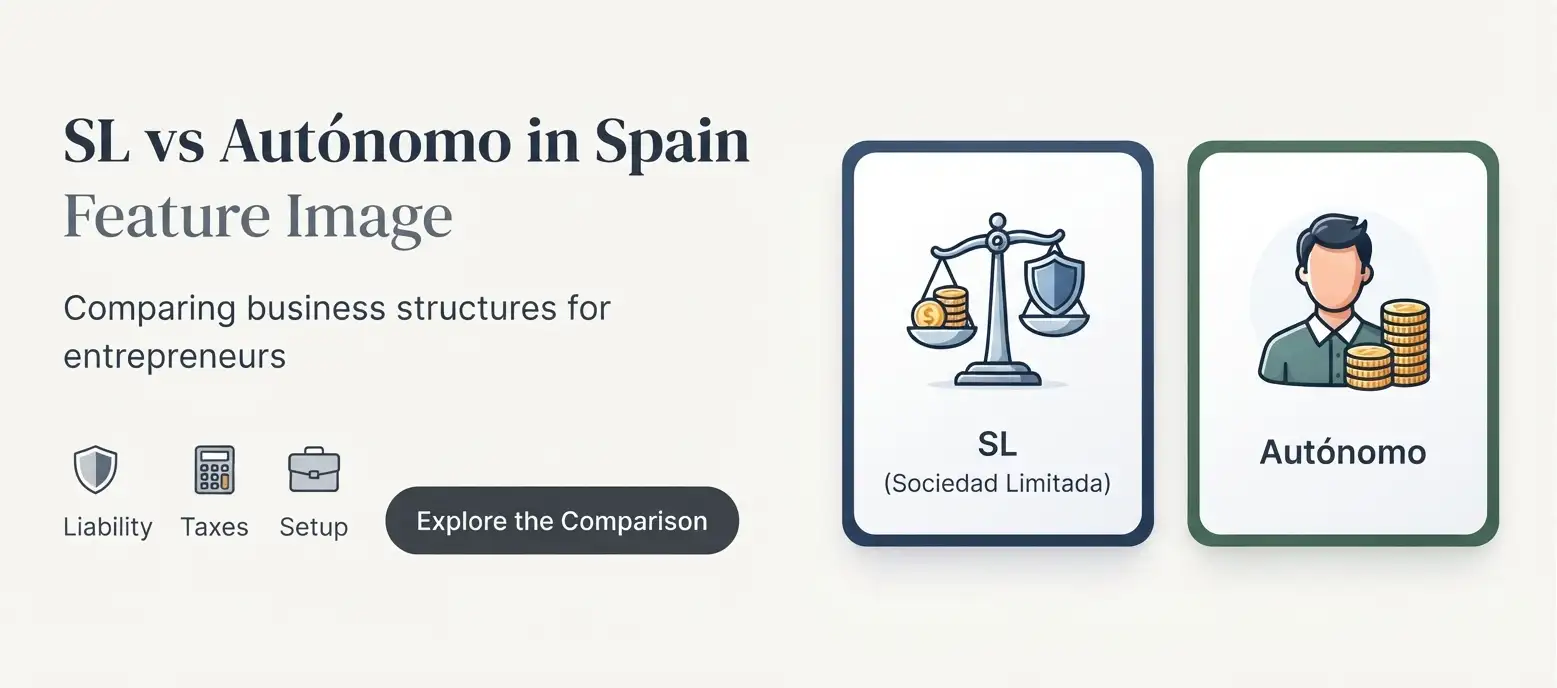
The two common options are working as an autónomo or creating a Sociedad Limitada (SL). An autónomo has a simpler setup and pays personal income tax (IRPF), but is personally liable with their own assets. An SL separates the owner’s assets from the business, pays corporate tax and has higher administrative costs. Many franchisees choose an SL when the investment is large or when they plan to open several outlets. Check whether the franchisor requires a specific structure.
Registering the Business
The steps differ by structure, but they generally follow this sequence:
| Step | Autónomo | Sociedad Limitada |
|---|---|---|
| Identification | NIE | NIE for each foreign shareholder and administrator |
| Banking | Spanish bank account | Bank account and share capital deposit |
| Formation | Registration with the tax authority (Modelo 036 or 037) | Name certificate, public deed before a notary and Commercial Registry registration |
| Social Security | Registration in the self-employed regime (RETA) | Registration of the company and its workers |
| Tax number | Included in your personal registration | Company tax ID (NIF) |
Hire a gestoría or lawyer to manage these filings, especially if you do not speak Spanish.
Obtaining Licences and Permits
Most outlets need a municipal licence or a responsible declaration (declaración responsable) before opening, depending on the activity and the town hall. Food businesses must also meet health and hygiene registrations, and some sectors require additional permits, such as terrace authorization, signage permits or professional qualifications. Check the rules with the local ayuntamiento before you sign the lease, because the premises must be suitable for the activity.
What Taxes Apply to Franchise Businesses in Spain?
A franchise outlet is taxed like any other Spanish business, and the taxes you pay depend on the structure you chose. If you operate as an autónomo, your profits are taxed through personal income tax (IRPF). If you operate through a Sociedad Limitada (SL), the company pays corporate tax (Impuesto sobre Sociedades), generally at 25% with reduced rates for new and small companies, and a further layer of tax applies when you take dividends.
| Tax | Applies To | Key Point |
|---|---|---|
| VAT (IVA) | Sales of goods and services | 21% general rate, 10% and 4% reduced rates for certain products, usually filed quarterly (Modelo 303) |
| IRPF | Autónomos | Progressive rates on business profit, with quarterly prepayments (Modelo 130 or 131) |
| Corporate tax | SL | Annual return (Modelo 200) plus advance payments |
| Payroll withholdings and Social Security | Employers | Monthly or quarterly filings and employer contributions |
| Municipal taxes | Premises | Business-related local charges, such as the IBI (if you own the premises) and the refuse collection fee |
| Transfer tax (ITP) | Premises purchases | Applies if you buy property, at regional rates |
Franchise payments also have tax effects. The entry fee, royalties and marketing contributions are generally deductible business expenses when properly invoiced, although the entry fee may need to be treated as an intangible asset and amortized over time. Royalties paid to a foreign franchisor can trigger withholding tax, which may be reduced under a double tax treaty, so check the contract and the treaty with your home country. Because rates, forms and deadlines change, confirm them with a Spanish tax advisor.
Can Buying a Franchise in Spain Lead to Residency?
Not automatically. For non-EU investors, buying a franchise does not grant the right to live or work in Spain, and a signed franchise contract does not guarantee a visa. Residency comes from a separate immigration route, with its own requirements and approval process.
The most relevant options are usually:
- Self-employment residence permit: generally requires a viability plan, sufficient funds, proof of qualifications or experience where relevant, and compliance with licensing rules.
- Entrepreneur visa: aimed mainly at innovative projects with economic interest for Spain, so a traditional franchise outlet rarely qualifies.
- Other routes: such as a work permit or family reunification, depending on your situation.
The real estate golden visa was repealed in April 2025, so do not rely on older guides that promise residency for an investment. EU/EEA citizens only need to register and obtain an NIE. Also remember that immigration residency and tax residency are different, so moving to Spain to run the outlet may change your personal tax position. Check the current rules before paying any franchise fee.
How Long Does It Take to Buy and Open a Franchise in Spain?
Most franchises take roughly three to twelve months from first inquiry to opening day, depending on the sector, the premises and your immigration status. A small service franchise can open faster, while a restaurant that needs works and a licence can take longer.
| Stage | Typical Duration | What Happens |
|---|---|---|
| Research and selection | 1 to 3 months | Compare brands, request information and attend meetings |
| Due diligence and negotiation | 1 to 2 months | Review the disclosure document, speak with franchisees and negotiate terms |
| Pre-contractual period | At least 20 days | Legal minimum between receiving the information and signing or paying |
| Financing and setup | 1 to 3 months | Bank approval, NIE, company incorporation and registrations |
| Premises and licences | 1 to 6 months | Lease, fit-out, municipal licence or declaración responsable |
| Training and opening | 2 to 6 weeks | Staff hiring, franchisor training and launch |
Many of these stages can run in parallel, but the premises and licence are the most common source of delay. Do not pay non-refundable fees until you know the location is viable for the activity.
What Are the Risks of Buying a Franchise in Spain?
A recognized brand lowers some risks, but it does not remove them. The most important ones include:
- Financial risks: underestimated investment, slower sales than projected, high royalties and a long break-even period.
- Contractual risks: unclear territory, mandatory suppliers at high prices, heavy penalties, difficult exit conditions and non-compete clauses after leaving.
- Franchisor risks: weak financial health, poor support, an unregistered trademark or a network that is closing more outlets than it opens.
- Operational risks: staffing difficulties, high rents, dependence on a single location and limited freedom to adapt the offer.
- Market risks: strong local competition, seasonality and a brand that does not fit Spanish consumer habits.
- Regulatory risks: unobtainable licences for the premises, changing labor or tax rules and sector-specific requirements.
- Immigration risks: committing capital before confirming that you can legally work in the outlet.
How to Protect Yourself When Buying a Franchise
Protection comes from independent checks before you pay anything. Follow this order:
- Confirm that the franchisor is registered in the Franchisor Registry and that you received the precontractual information at least 20 days before signing.
- Hire an independent Spanish lawyer, and an accountant if the investment is significant.
- Speak with several current and former franchisees, not only those recommended by the franchisor.
- Build your own financial forecast using real local rent, salaries and royalties.
- Verify the trademark registration and who owns it.
- Secure the premises and confirm the licence is viable before paying non-refundable fees, ideally with a clause that lets you withdraw if the licence is refused.
- Negotiate clear territorial exclusivity, reasonable exit terms and limits on mandatory purchases.
- Resolve your visa or registration route before committing capital.
- Keep a cash reserve for the first months of operation.
A serious franchisor will welcome these checks. If you feel pressure to sign quickly, treat it as a warning sign.
Summary
Foreigners can buy a franchise in Spain on the same legal basis as Spanish citizens, because a franchise is a commercial contract between two independent businesses. The real questions are practical: whether you can legally work in the outlet, how you will structure the business (autónomo or Sociedad Limitada) and whether the premises can obtain the required licence. Start by choosing a sector and format that match your budget and experience, then compare brands by their presence in Spain, their track record and the real performance of existing outlets.
Before signing, confirm that the franchisor is registered in the Franchisor Registry, that you received the precontractual information at least 20 days in advance and that the trademark is properly registered. Review the franchise agreement carefully, paying attention to fees and royalties, contract duration, renewal, territorial exclusivity, mandatory suppliers and post-contractual restrictions. Build your own financial forecast, speak with current and former franchisees, and keep a cash reserve for the first months.
Plan the financing, taxes and setup together: bank loans and public guarantee lines, VAT and income or corporate tax, company registration and municipal licences. Remember that buying a franchise does not grant residency, so non-EU investors should secure an immigration route before paying any fee. Independent legal and tax advice remains your best protection. For the complete overview of the sector, read our pillar guide, Franchising in Spain.
Frequently Asked Questions About Buying a Franchise in Spain
Can a foreigner buy a franchise in Spain?
Yes. Spain places no general nationality or residency requirement on franchisees, and foreign investors can sign a franchise agreement and operate an outlet like any Spanish buyer. EU/EEA citizens need an NIE and can register as autónomo or create an SL. Non-EU investors need a separate residence and work authorization if they plan to run the outlet themselves.
How much money do I need to buy a franchise in Spain?
It varies widely by sector and format, from a few thousand euros for a small service franchise to several hundred thousand for a restaurant or large store. Budget for the entry fee, fit-out and equipment, initial stock, lease deposit, licences and working capital, and check which recurring fees apply, such as royalties and marketing contributions.
Is buying a franchise in Spain profitable?
It can be, but profitability depends on the brand, the location, your costs and how well you manage the outlet, not on the franchise model alone. Ask for the real results of existing outlets, build your own forecast using local rent, salaries and royalties, and calculate the break-even point before committing. Be cautious with projections that are not backed by data from operating franchisees.
What should I check before signing a franchise agreement?
Confirm the franchisor’s registration in the Franchisor Registry, receipt of the precontractual information at least 20 days before signing or paying, and the trademark registration. Review the fees, duration, renewal terms, territory, mandatory suppliers and exit clauses, and speak with current and former franchisees. Hire an independent Spanish lawyer who does not work for the franchisor.
Can I get financing to buy a franchise in Spain?
Yes, though banks usually expect a meaningful personal contribution and a solid business plan, and non-resident applicants often face stricter conditions. Options include bank loans, ICO-backed lines, guarantees from reciprocal guarantee companies (SGR), leasing for equipment, private investors and, in some cases, staged payments offered by the franchisor.
Can buying a franchise in Spain give me residency?
Not automatically. A franchise contract does not grant the right to live or work in Spain. Non-EU investors need a separate route, such as a self-employment residence permit, which generally requires a viability plan and sufficient funds. The entrepreneur visa mainly targets innovative projects, so a traditional franchise outlet rarely qualifies. EU/EEA citizens only need to register and obtain an NIE.
Please have a Spanish lawyer verify the precontractual deadline, the registry requirements and the immigration routes before publishing, since they can change.