Have you ever looked at Spain’s startup scene, its growing tech hubs in Madrid and Barcelona, its access to a European market of more than 440 million consumers, and wondered whether a door like that is really open to someone who wasn’t born there? Or maybe you are further along. You already have a business idea, a budget, and a timeline, but one question keeps stalling your plans: do you need to move to Spain first, or can the company come before the move?
Many foreign founders lose weeks, and sometimes thousands of euros, because they begin in the wrong order. Some sign documents before holding the right tax identification number. Others choose a legal structure without realizing it affects their residence options. And a surprising number assume the rules are the same for everyone, when your passport can change the route you take.
This guide follows the path real entrepreneurs take, from the first legal question to a registered and operating company. Before any paperwork, though, there is one point that shapes everything else, and it begins with a simple question: what does Spain actually require of you, and what depends on where you come from? Let’s start there.
Can Foreign Entrepreneurs Set Up a Company in Spain?
Yes. Spanish law does not prevent foreign nationals from forming a company or owning it, and in most cases a foreigner can hold 100% of the shares of a Spanish company. There is no requirement to have a Spanish partner or a Spanish-born director. What changes from one entrepreneur to another is not the right to own a business, but the right to live and work in Spain while running it. That difference is where your nationality matters, and it is why the process splits into two distinct paths.
Owning shares and working in the business are treated as two separate legal questions. A foreign investor can be a shareholder (socio) of a Spanish Sociedad Limitada (SL) without ever living in the country. However, if that same person wants to reside in Spain, manage the company day to day, or draw a salary as an administrator, immigration rules come into play. The sections below explain how this works for each group. For a broader view of the whole process, including taxes, banking, and legal forms, see our guide on Starting a Business in Spain.
EU/EEA Entrepreneurs
Citizens of EU and EEA countries, along with Swiss nationals, benefit from free movement rights, which makes company formation in Spain considerably more straightforward. You do not need a visa, a work permit, or a special entrepreneur authorization. You can incorporate a company, act as its administrator (administrador), and register as self-employed (autónomo) under the same general conditions as a Spanish citizen.
The practical requirements are more administrative than legal. The first is the NIE (Número de Identidad de Extranjero), the tax identification number that every foreigner needs to sign a deed of incorporation, open a business bank account, or deal with the Spanish tax authority (Agencia Tributaria). The second applies if you plan to stay in Spain for more than three months: you must register in the Central Register of Foreign Nationals and obtain the certificado de registro de ciudadano de la Unión Europea. This certificate is a registration document, not a residence permit, and it is usually requested at a police station or immigration office (Oficina de Extranjería).
A useful point for founders who are not ready to relocate: an EU/EEA citizen can start the incorporation from abroad, either by granting a power of attorney (poder notarial) to a representative in Spain or by travelling only to sign the deed. Residence in Spain is not a condition for creating the company, but it does become relevant for tax purposes once you spend more than 183 days a year in the country.
Non-EU Entrepreneurs
Entrepreneurs from outside the EU/EEA, including citizens of the United States, the United Kingdom after Brexit, Canada, Latin American countries, and most of Asia and Africa, can also own and incorporate a Spanish company. The legal capacity to be a shareholder does not depend on nationality, and the same NIE requirement applies. The difference appears when you want to work in or from Spain, because the right to live and carry out an economic activity must be authorized separately.
Holding shares as a passive investor is possible without residing in Spain. Being an active founder who lives in the country is different, and you will need an appropriate authorization. The most common routes are summarized below.
| Route | Who it is for | Key point |
|---|---|---|
| Entrepreneur visa and residence (visado y autorización de residencia para emprendedores) | Founders of innovative or high-value business projects | Requires a favorable report on the project, typically issued through ENISA or the competent public body |
| Self-employed residence and work permit (autorización de residencia y trabajo por cuenta propia) | Founders who will run a small or traditional business themselves | Requires a viable business plan, proof of funds, and any licenses needed for the activity |
| Digital nomad visa | Remote workers employed by or serving companies outside Spain | Designed for remote work, not for building a Spanish operating business |
| Residence through family ties or another existing permit | Spouses or relatives of EU citizens, or people already holding work authorization | May allow you to run a company without a separate entrepreneur permit |
Choosing the right route matters, because a mismatch can cause delays or even a refusal. For example, the non-lucrative visa does not permit professional or business activity, so it is not a suitable base for running your Spanish company. Immigration rules and eligibility criteria are updated periodically, so confirm the current requirements with the Spanish consulate in your country or a qualified immigration lawyer before submitting an application.
If you hold a UK passport, note that you are now treated as a non-EU national, unless you qualify under the Withdrawal Agreement as a beneficiary who was already resident in Spain before the transition period ended.
Choose the Right Business Structure
The legal form you pick shapes almost everything that follows: how much personal risk you carry, how you are taxed, what you pay in social security, and how easily you can bring in partners or investors. For foreign entrepreneurs there is an added layer, because the structure also affects your residence options and the paperwork your immigration route requires. Spain offers several forms, but in practice most foreign founders choose between three: the self-employed route (autónomo), the Sociedad Limitada (SL), and, in specific cases, the Sociedad Anónima (SA).
A common mistake is choosing a structure for its setup cost alone. A structure that looks cheap on day one can become expensive once your income grows, once you hire your first employee, or once you need to separate your personal assets from the business.
Autónomo vs. Sociedad Limitada (SL)
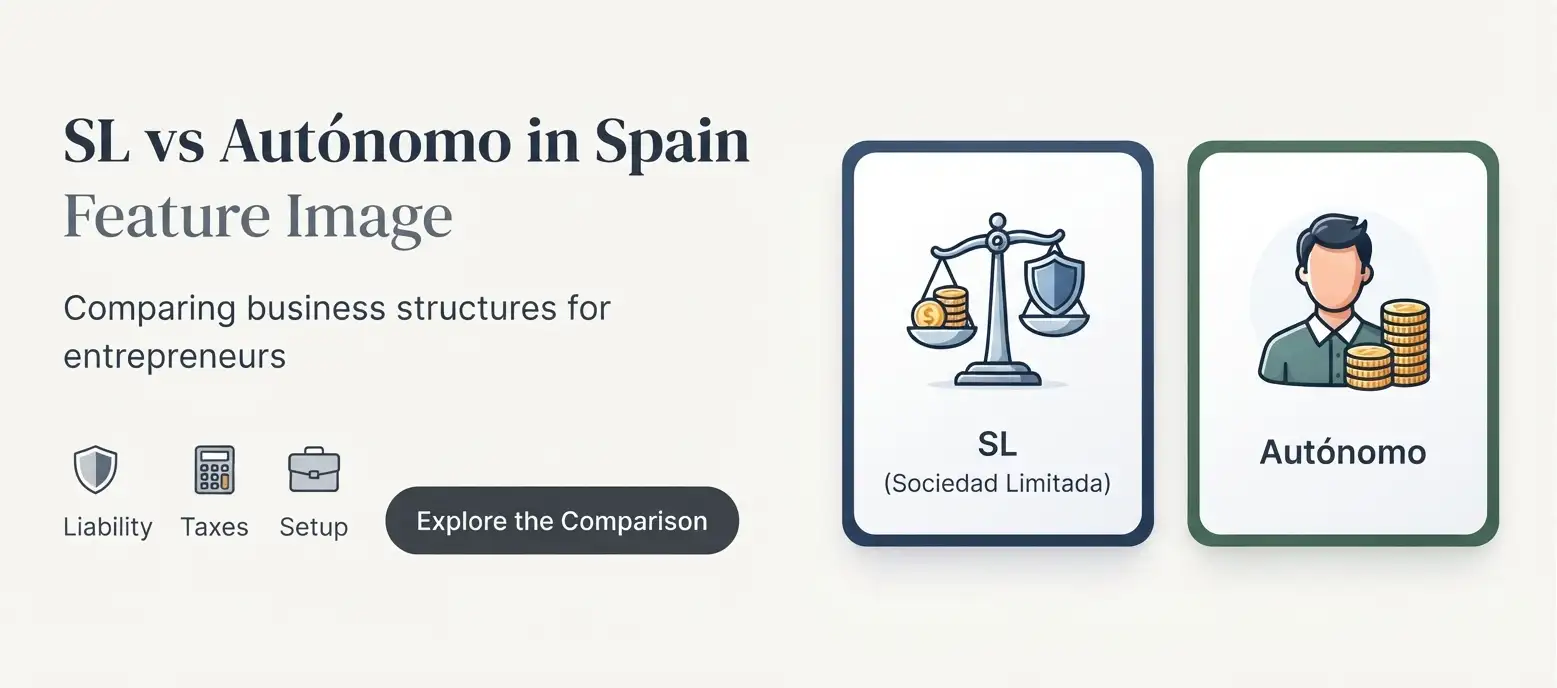
The autónomo is not a company. It is a registration of you as an individual who carries out an economic activity in your own name. Setup is fast and inexpensive, with no notary or Mercantile Registry involved, but you carry unlimited personal liability. If the business incurs debts, your personal assets can be reached. Your profits are taxed as personal income (IRPF) on a progressive scale, and you pay monthly social security contributions based on your net earnings, with reduced rates usually offered during the first months of activity.
The SL is a separate legal entity. Partners are liable only up to the capital they contribute, which is the main reason most foreign founders prefer it once the business involves real risk, contracts, or employees. Since the Ley Crea y Crece reform, the legal minimum share capital is just €1. There is an important condition, though: until the company’s capital plus reserves reaches €3,000, it must allocate at least 20% of its profits to the legal reserve, and partners can be jointly liable for the difference if the company is liquidated with insufficient assets. Many advisers therefore still recommend contributing €3,000 from the start, because banks, clients, and suppliers often read a very low capital figure as a weak signal.
Taxation is where the choice often becomes decisive. An SL pays corporate tax (Impuesto sobre Sociedades) at a general rate of 25%, with a reduced rate available to newly created companies in their first profitable years, while an autónomo’s rate rises as income rises. As a rough guide, many advisers consider the SL more efficient once annual profits reach a level where the personal income tax rate would clearly exceed the corporate rate, but the right threshold depends on your situation.
| Criteria | Autónomo | Sociedad Limitada (SL) |
|---|---|---|
| Legal personality | None, you are the business | Separate legal entity |
| Liability | Unlimited, personal assets exposed | Limited to capital contributed |
| Minimum capital | None | €1 (with reserve rules until €3,000) |
| Taxation | Personal income tax (IRPF), progressive | Corporate tax, 25% general rate |
| Setup process | Registration with tax and social security authorities | Notary deed, name certificate, Mercantile Registry |
| Best for | Freelancers, consultants, low-risk activities | Businesses with partners, employees, or growth plans |
For a non-EU founder, there is one more practical point. An entrepreneur residence application is typically built around a business plan, and the structure you describe in it should match what you later register. Decide with your adviser before submitting an immigration file, not after.
When Should You Consider an SA?
The Sociedad Anónima (SA) is designed for larger or more capital-intensive projects. The minimum share capital is €60,000, and at least 25% of the nominal value of each share must be paid in at incorporation, with the rest payable later under the terms set in the bylaws. That threshold alone rules it out for most first-time founders.
So why would a foreign entrepreneur choose it? The SA makes sense when your plans involve outside investors, a large number of shareholders, or an eventual listing on a stock exchange, since shares in an SA are easier to issue and transfer than SL interests. It can also suit a foreign group setting up a Spanish subsidiary where a corporate image of scale and stability matters to local partners. In sectors with high regulatory requirements, such as certain financial or insurance activities, an SA or a similar structure may be required by law.
If you are launching a first business, testing a market, or working with a small number of partners, the SL is almost always the more practical vehicle, and it can later be converted into an SA if your needs change.
Obtain the NIE and NIF
Spain identifies every taxpayer with a number, and without the right one you cannot sign a deed of incorporation, open a business bank account, or register with the tax authority. Two terms cause most of the confusion: the NIE and the NIF. They are related but not identical, and foreign founders need to understand both.
The NIE (Número de Identidad de Extranjero) is the personal identification number assigned to foreign nationals who have economic, professional, or social ties with Spain. For an individual, the NIE also works as the tax identification number, so when a form asks for your NIF as a foreign person, you provide your NIE. You need one before incorporating, and every foreign partner and administrator in the company must have their own.
The NIF (Número de Identificación Fiscal) is the tax identification number of the company itself. It is a different number from yours and is issued to the SL once it exists as an entity. This is why the sequence matters. Your personal NIE comes first, and the company’s NIF comes after the deed is signed.
You can request the NIE in several ways: in person at a police station or Oficina de Extranjería in Spain, at a Spanish consulate in your home country, or through a representative holding a power of attorney. The usual application is form EX-15, together with your passport, a justification of why you need the number (for example, the planned company formation), and proof of payment of the fee (Modelo 790, código 012), which is currently only around €10 to €12. Appointments (cita previa) can be hard to find in large cities, so build some extra time into your schedule. Many founders in a hurry use a lawyer or gestoría to handle it.
Once the deed of incorporation is signed, the company requests its tax identification number from the Agencia Tributaria. This happens in two stages:
- Provisional NIF: Requested using the deed of incorporation, before the company is registered. The Spanish tax office expects this application within 30 working days of signing the deed, and the provisional card is valid for up to six months. For an SL it begins with the letter B, and for an SA with the letter A.
- Definitive NIF: Issued after the company is registered in the Registro Mercantil. You submit proof of registration to the tax authority to exchange the provisional number for the permanent one.
If a foreign company, rather than an individual, will be a shareholder, it also needs a Spanish tax identification number, so include that in your planning from the start.
Choose and Reserve Your Company Name
Choosing a name for a Spanish company is not only a branding decision. It is a legal step with its own certificate, deadlines, and rules. In Spain, the corporate name (denominación social) must be unique, and the body responsible for checking this is the Registro Mercantil Central (RMC) in Madrid. The RMC makes sure no two companies carry identical names or names that could cause confusion, so a name that is only slightly different from an existing one can still be rejected.
A few rules help you avoid wasted attempts. The name cannot be identical or confusingly similar to a registered company. It cannot include words that suggest official or institutional status, such as Nacional or Estatal, without authorization. It also cannot be offensive or begin with a number. The name must end with the legal form, such as Sociedad Limitada or its abbreviation S.L., so that third parties know what kind of entity they are dealing with. Keep in mind that the corporate name is different from your brand or trademark. A name approved by the RMC does not protect your brand, so it is wise to run a separate search with the Spanish Patents and Trademarks Office (OEPM) and check domain availability at the same time.
The process works as follows:
- Prepare several options. You can propose up to five names in one application, and the registry grants the first available one, so list them in order of preference.
- Apply for the certificación negativa de denominación social. The request is submitted to the RMC, online or in writing, in the name of one of the future partners. That person becomes the named applicant on the reservation.
- Pay the fee. The cost is roughly €16, though fees can change, so check the current amount when you apply.
- Receive the certificate. Online requests are often answered within one to two working days.
- Sign the deed at the notary on time. This is the step where founders most often lose their reservation.
The deadlines are strict. The certificate itself is valid for three months for use in the deed of incorporation, while the name stays reserved in your favor for up to six months. A Spanish official bulletin ruling from 2026 shows what happens when this goes wrong: a deed was refused registration because more than six months had passed since the name certificate was issued. In that case, the founders had to restart the process with a new certificate and a new declaration.
Because older guides cite shorter periods (some still mention two months), treat the certificate’s printed validity as the controlling date and coordinate your notary appointment before you apply for the name. For foreign entrepreneurs who still need to organize their NIE, bank deposit, and signing trip, the practical approach is to reserve the name only when the rest of the file is nearly ready. The next step in the process is the capital deposit and the signing of the deed at the notary, which we cover in the following section.
Prepare the Company’s Articles of Association
The articles of association (estatutos sociales) are the internal constitution of your company. They set out how it is governed, who decides what, and how shares are transferred. For a foreign founder, they matter more than they seem, because they are the document that defines who can act on behalf of the company when you are not in Spain, and how disagreements between partners will be resolved. The Spanish Companies Act (Ley de Sociedades de Capital) lists the minimum content they must include, and a deed that omits any of it will not be registered.
Most of the work is deciding on the corporate purpose and the administration system. The corporate purpose (objeto social) describes the activities the company may carry out, and it should be broad enough to cover your growth plans without being so vague that a registrar rejects it. Many founders add a wide list of activities, but a purpose that is too narrow can later force a bylaw amendment before a notary every time the business expands. The administration system can be a sole administrator, two joint administrators, several administrators acting separately, or a board of directors. For a single foreign founder who wants full control, the sole administrator is the simplest option, while two partners often prefer joint administration so that each decision carries both signatures.
| Required element | What to define | Practical note for foreign founders |
|---|---|---|
| Name (denominación) | The corporate name approved in the negative certificate | Must match the certificate exactly |
| Corporate purpose | The activities the company will carry out | Keep it broad but precise |
| Registered address (domicilio social) | The place where the company is based and managed | Must be a real Spanish address, which can be a business center or office |
| Share capital | Amount and number of shares (participaciones) | Minimum €1 for an SL, with the reserve rules explained earlier |
| Administration system | Sole, joint, several, or board | Directly affects who can sign and bind the company |
| Administrator remuneration | Whether the administrator is paid | If paid, the bylaws must say so, which also affects Social Security |
| Fiscal year and duration | Usually the calendar year, with indefinite duration | Calendar year is the standard choice |
| Transfer rules | Conditions for selling or transferring shares | SL shares are not freely transferable by default |
Two details deserve special attention. First, the remuneration of administrators must be expressly stated in the articles. If the bylaws are silent, the position is presumed to be unpaid, and a founder who later wants to pay themselves a salary as administrator may need to amend them. Second, you can use the standard model bylaws (estatutos tipo) offered through the government’s online incorporation system, which speeds up the process but offers less flexibility. If you are forming the company with partners, consider a separate shareholders’ agreement (pacto de socios) for matters such as exit terms, because those clauses stay private, whereas the articles become public once registered.
Open a Business Bank Account and Provide the Share Capital
Before signing at the notary, the company needs a place to receive its share capital. In Spain this means opening a bank account in the name of the company in formation, depositing the contributions of the partners, and obtaining proof of that deposit. The sequence matters, because the notary will normally want evidence of the capital before the deed can be signed.
This is often the most time-consuming practical step for non-residents. Spanish banks apply strict anti-money-laundering checks and will ask for the passports and NIEs of all partners, a description of the business, and sometimes proof of the origin of funds. Founders who do not yet live in Spain may find that some branches are cautious about non-resident clients, so it helps to approach banks that regularly serve international customers or to ask your adviser for an introduction. Here is how the process usually runs:
- Obtain your NIE and make sure it is valid for use with the bank.
- Hold the name certificate. Most banks ask for the certificación negativa to open the account in formation.
- Open the account in the name of the company in formation, with the planned administrator as signatory.
- Deposit the share capital. Each partner pays their contribution in euros.
- Request the deposit certificate (certificado de ingreso) to present to the notary.
The money is not locked away. After incorporation, the company can use the funds freely for its operations, and many founders ask whether the deposit is simply a formality. It is more than that, because the amount you commit signals financial seriousness to clients and suppliers, and any shortfall can create liability for the partners in the event of insolvency. Contributions can also be made in kind (aportaciones no dinerarias), such as equipment or intellectual property, but these require a valuation and add complexity, so most foreign founders contribute cash.
Rules on how the notary verifies capital have been simplified in recent years, so ask your notary what proof they currently require. If your investment comes from abroad, you will also need to file a foreign investment declaration (declaración de inversiones exteriores) with the Spanish authorities, usually handled through the bank or notary, and certain sensitive sectors can require prior authorization.
Sign the Deed of Incorporation Before a Notary
An SL is not created by a private contract. In Spain, the founders must sign a public deed (escritura pública de constitución) before a notary, who verifies identities, checks that the documents are legally valid, and records the act in an official protocol. The notary is the legal gatekeeper at this stage, and nothing is registered without the notary’s signature.
On the day of signing, the notary will check the following:
- The passports and NIEs of all partners and administrators
- The negative name certificate, which must still be valid
- The articles of association, which are attached to the deed
- Proof of the share capital deposit
- The declaration of the company’s beneficial owners (titularidad real), required under anti-money-laundering law
Foreign founders have a few extra points to plan. If you cannot attend in person, you can grant a power of attorney (poder notarial) to someone in Spain. A power of attorney signed abroad usually needs to be legalized with an apostille and translated into Spanish by a sworn translator, which adds time, so start it early. If you do not speak enough Spanish to understand the deed, the notary may require an interpreter or a bilingual version, because the deed must be fully understood by the signers. Recent digitalization reforms have also made remote and electronic incorporation more accessible, so ask whether your notary offers it before you book a trip.
The costs at this stage consist of the notary’s fees (aranceles), which depend on factors such as the capital and the length of the documents, and a tax filing. Company formation itself is exempt from the transfer and stamp duty (ITP-AJD), but the exemption must still be declared to the regional tax office, and the Mercantile Registry will ask for proof of that filing. Most notaries or gestorías handle this for you.
Once the deed is signed, the company exists as a contract between the partners, but it does not yet have full legal personality. That comes with registration.
Register the Company With the Mercantile Registry
The signed deed must be filed with the Mercantile Registry (Registro Mercantil) of the province where the company’s registered address is located. The deadline is short: filing is expected within two months of the deed being signed, and in practice the notary or your gestoría usually submits it electronically within days.
Registration is the legal turning point. A company acquires its own legal personality only once it is registered, and this is what creates the limited liability that most founders seek. Until that moment, the company is considered “in formation” (sociedad en formación), and anyone who has acted on its behalf can be held personally responsible for the obligations they contracted. For that reason, avoid signing leases, supplier contracts, or employment agreements in the company’s name before registration is complete, unless you accept that risk.
The registrar reviews the deed to confirm it complies with the law, a process known as calificación. If there is a defect, such as a corporate purpose that is unclear or a missing document, the registrar issues a notice that must be corrected before registration proceeds. Timing varies by province, and standard-bylaw incorporations through the online system are typically faster than customized deeds. After approval, the company’s details are published in the BORME (Boletín Oficial del Registro Mercantil), the official gazette, which makes the company’s existence public.
The registry also holds the company’s mandatory corporate books, including the register of partners and the minutes book, and from this point you will need to deposit your annual accounts there each year. Registry fees depend on the capital and the type of filing, so ask your adviser for a precise estimate at the start.
Obtain the Company’s Tax Identification Number
The company’s NIF is obtained in two stages, and the order creates a common source of delay. Your personal NIE identifies you, while the NIF identifies the company in all tax matters. It is the number that appears on invoices, tax returns, bank accounts, and contracts.
The first stage happens right after the deed is signed. You apply for a provisional NIF at the Agencia Tributaria using the tax form Modelo 036, attaching a copy of the deed and the identification of the legal representative. This provisional number lets the company operate while registration is in process, for example to open a regular business account or invoice customers. It is valid for six months and, for an SL, begins with the letter B.
The second stage comes once the company is registered. You return to the tax authority with proof of registration to exchange the provisional number for the definitive NIF. If you miss this step, the provisional number can expire, which leads to blocked tax procedures and extra paperwork. Make it a fixed item on your checklist.
A practical tip for foreign founders: you will need a way to interact electronically with the tax agency. Companies are required to use electronic channels, so request an electronic certificate for the legal representative or an alternative identification method early, and set up access to the Dirección Electrónica Habilitada Única (DEHú), where official notifications are delivered. Notifications left unread there can be deemed served after ten calendar days, and many foreign founders have missed deadlines because they did not know the mailbox existed.
Register the Business Activity With the Tax Agency
Having a NIF does not by itself authorize you to start trading. The company must also declare its business activity through the census declaration (declaración censal), which is filed with the same Modelo 036 and tells the tax authority what you do, where you do it, and which taxes apply.
In this declaration you state your activity, your registered address, and your tax regime. Several decisions are made here:
- VAT (IVA): The company registers as a VAT taxpayer. The general rate is 21%, with reduced rates of 10% and 4% for specific goods and services, and returns are generally filed quarterly (Modelo 303).
- Business activity tax (IAE): Companies must register under an activity heading, but most newly created small companies, and any company with a net turnover below €1 million, are exempt from paying it.
- EU operations: If you will sell to or buy from other EU countries, request registration in the Register of Intra-Community Operators (ROI).
- Withholdings: If you will pay employees or professionals, the company will have to withhold income tax and file periodic returns (Modelos 111 and 190).
Corporate tax is filed annually (Modelo 200), and companies make advance payments during the year. The first full cycle usually surprises founders because the deadlines fall outside the calendar quarters they are used to, so ask your adviser for a tax calendar at the start.
Beyond tax, check whether your activity needs a municipal license or declaration (declaración responsable or licencia de apertura) from the town hall, and whether your industry has sector-specific permits. Spain is also rolling out mandatory invoicing-software rules (known as VeriFactu) with phased deadlines that have been postponed more than once, so confirm the current dates when selecting your billing system.
Register With Social Security
The final step before operating is registration with the Social Security system (Tesorería General de la Seguridad Social, TGSS). Which type of registration applies depends on who is working in the company and in what role, so it helps to separate the cases.
| Person | Typical Social Security regime | Key point |
|---|---|---|
| Partner-administrator who controls the company | Self-employed regime (RETA), often called autónomo societario | Generally applies when the person holds a controlling stake and performs management duties |
| Administrator without control, with remunerated management functions | General regime, as an equivalent to an employee | Does not usually include unemployment protection |
| Employees | General regime | The company must register first and then enroll each worker |
| Partner who does not work in the company | Not required | Holding shares alone does not trigger registration |
The controlling-stake test is what often catches foreign founders. As a general rule, a partner who holds at least one third of the capital and also manages the company is treated as self-employed, and lower thresholds can apply when family members are involved. This means that a founder who owns 100% of an SL and runs it will normally pay monthly self-employed contributions even while the company has no income. New self-employed workers can often access a reduced flat rate (tarifa plana) during the first year, though the amount and conditions change periodically, so verify current rules.
If you will hire staff, the company must first register as an employer and obtain a contribution account code (código de cuenta de cotización), then register each employee before they start work. Employers’ social security contributions typically add roughly 30% or more on top of gross salary, depending on the contract and sector, so factor that into your hiring budget. Each person registered also needs a Social Security number (número de afiliación), which requires a valid NIE and, for non-EU nationals, the proper work authorization. Immigration status and Social Security registration are linked, so make sure your residence permit allows you to work in the way you plan to.
Once Social Security registration is complete, the company has all the registrations it needs to operate legally. In the next section, we cover the final post-incorporation obligations that keep the company in good standing.
Obtain the Required Business Licences and Permits
Incorporating the company does not automatically authorize every activity. Many businesses need a licence or authorisation before they open, and the requirements depend on what you do and where you do it. Municipal rules usually come first. A shop, restaurant, workshop, or office open to the public normally needs a declaración responsable or an opening licence (licencia de apertura) from the town hall, and the procedure differs from one city to another.
Regulated sectors add their own layer. Health, financial services, gambling, transport, food production, education, and tourism accommodation are supervised by regional or national bodies, and some require authorisation before you start. Regional governments also set rules, so a business in Catalonia may follow a different procedure from one in Andalusia. Before signing a lease, check with the town hall whether the premises are legally approved for your activity, because that is the mistake that costs founders the most.
Can You Complete Company Formation Online in Spain?
Yes, in many cases. Spain’s CIRCE system (Centro de Información y Red de Creación de Empresas) lets entrepreneurs process most incorporation steps through a single electronic file, the DUE (Documento Único Electrónico). Instead of visiting the notary, tax office, and registry separately, the information is submitted once through an assisted point (PAE, Punto de Atención al Emprendedor), and the system coordinates the other bodies.
What the online route covers:
- Reserving the company name
- Preparing the deed with a notary
- Requesting the provisional NIF
- Filing for registration at the Mercantile Registry
- Starting some tax and Social Security registrations
The fastest path is usually a standard-bylaw SL, which can be completed within days. Custom articles, in-kind contributions, or foreign partners usually require a traditional process. Even then, a foreign founder still needs a NIE and a bank deposit first, so “online” does not remove the identification steps. Ask your adviser which parts can be handled remotely in your case.
How Long Does It Take to Form a Company in Spain?
The answer depends more on preparation than on the government. Once all documents are ready, a straightforward SL can be formed in roughly one to three weeks, and standard online incorporations can be faster. A custom deed with foreign partners often takes three to six weeks in total.
| Stage | Typical timeframe |
|---|---|
| NIE (if you don’t have one) | Days to several weeks, depending on appointments |
| Name certificate | 1 to 2 working days |
| Bank account and capital deposit | A few days to several weeks, depending on the bank |
| Notary deed | Same day once documents are ready |
| Mercantile Registry | A few days to a couple of weeks |
| Definitive NIF and tax registrations | A few days after registration |
The slowest points are usually the NIE appointment, the bank’s due diligence, and legalised powers of attorney from abroad. Treat these as the critical path and start them first.
How Much Does It Cost to Form a Company in Spain?
The official costs are modest, but the total depends on whether you hire help. These ranges are indicative and change by region, notary, and complexity, so request a written quote.
| Item | Approximate cost |
|---|---|
| Name certificate (RMC) | Around €16 |
| NIE fee | Around €10 to €12 per person |
| Notary fees | Often €100 to €300 for a standard deed |
| Mercantile Registry | Often €40 to €150, plus publication costs |
| Share capital | From €1, commonly €3,000 |
| Lawyer or gestoría | Commonly several hundred euros, more for complex cases |
| Sworn translations and apostilles | Variable, per document |
Beyond formation, plan for the costs that arrive immediately afterwards: monthly self-employed Social Security contributions for the administrator, accounting services, and an electronic certificate. Founders often budget for incorporation and forget the first six months of running costs.
Can You Form a Spanish Company Without Living in Spain?
Yes. Residence is not a legal condition for owning shares in an SL or for being a shareholder, and you can complete much of the process through a power of attorney or a single trip to sign. Non-resident founders still need a NIE, a Spanish registered address, a bank account for the capital, and a way to receive official notifications.
Management is where the limits appear. A non-resident can in principle be named administrator, but if you are a non-EU citizen who will work in Spain, you need the correct immigration authorisation. Banks and the tax authority also ask more questions about companies run entirely from abroad. If you do not plan to move, appoint a trusted local representative, use a professional registered address, and keep tax residence in mind: a company managed from outside Spain can raise questions about where it is tax resident.
Does Forming a Company in Spain Give You Residency?
No. Creating a company gives you ownership of a business, not the right to live or work in Spain. These are two separate legal tracks, and one does not produce the other. A company can be registered with a founder living abroad, and a founder without the correct permit cannot legally work in it just because they own it.
Residence comes from a separate immigration application, such as the entrepreneur route for innovative projects, a self-employed residence and work permit, or, for larger investments, the investor route (the real estate version was discontinued in 2025, so check which options remain). Each has its own requirements, such as a business plan, proof of funds, and in some cases a favorable report from the competent body. For EU/EEA citizens the route is simpler and based on registration rather than a permit. Our guide on Starting a Business in Spain explains how the company and immigration steps fit together.
What to Do After Registering Your Company
Once the company is registered and has its NIF, a short list of tasks keeps it compliant and ready to trade:
- Open the operating account and move the capital to it if needed, and keep business and personal finances separate.
- Set up accounting. Spanish companies must keep formal books and file annual accounts, so hire an accountant or gestoría from the start.
- Activate electronic access: a digital certificate, the tax agency portal, and the DEHú mailbox for official notices.
- Handle data protection and invoicing: comply with GDPR if you process personal data, and use invoicing software that meets Spanish rules.
- Register employees and comply with labour obligations before they begin work.
- Take out insurance as needed, such as civil liability, which some activities require.
- Calendar your deadlines: quarterly VAT, annual corporate tax, and the deposit of annual accounts at the Mercantile Registry.
The first months set the pattern for the company’s compliance. A simple tax calendar and a reliable local adviser prevent most of the penalties that new foreign-owned companies face.
Summary
Forming a company in Spain is a structured process, and the order of the steps matters more than any single one. Foreign founders can own 100% of a Spanish company, but ownership and the right to live and work in Spain are separate questions, and your nationality decides the second.
In practice, the route runs as follows:
- Confirm your legal and immigration position (EU/EEA or non-EU).
- Choose your structure, most often an autónomo or an SL.
- Obtain your NIE.
- Reserve the company name at the Registro Mercantil Central.
- Prepare the articles of association.
- Open a bank account and deposit the share capital.
- Sign the deed before a notary.
- Register at the Mercantile Registry and obtain the definitive NIF.
- Register the activity with the tax agency and with Social Security.
- Obtain any licences your activity requires.
Frequently Asked Questions About Company Formation in Spain
Can a foreigner open a company in Spain?
Yes. Spanish law allows foreign nationals to form and fully own a company, with no requirement for a Spanish partner or director. What varies is the right to work in Spain, which depends on your nationality and immigration status.
Can I start a company in Spain without living there?
Yes. You can incorporate through a power of attorney or a single trip to sign the deed. You still need a NIE, a Spanish registered address, and a bank account for the capital. If you are a non-EU citizen and want to work in the company in Spain, you will need the proper authorisation.
Do I need an NIE to form a company in Spain?
Yes. Every foreign partner and administrator needs a NIE to sign the deed, open the bank account, and deal with the tax authority. It can be requested in Spain, at a Spanish consulate, or through a representative.
What is the minimum capital required to start an SL in Spain?
The legal minimum is €1. Until capital plus reserves reaches €3,000, the company must set aside part of its profits and partners may carry extra liability on liquidation, so many founders start with €3,000.
How long does it take to register a company in Spain?
A straightforward SL usually takes about one to three weeks once documents are ready, and a custom deed with foreign partners often takes three to six weeks. The NIE, bank account, and legalised powers of attorney are the usual bottlenecks.
Does opening a company in Spain give me residency?
No. A company gives you a business, not a right of residence. Residency requires a separate immigration application, such as an entrepreneur or self-employed permit, while EU/EEA citizens register instead of applying for a permit.